




In the commercial display industry, LED (Light Emitting Diode) is the undisputed king. From massive roadside billboards to the smartphone in your hand, it is everywhere. But have you ever wondered how this tiny "jelly-like" component emits such brilliant light with just a small amount of electricity?
The working principle of an LED is not a mystery; it can be visualized as a "Microscopic High-Dive Competition."
I. The Core Structure: Two Special "Semiconductors"
To understand an LED, you first need to know its heart—the PN Junction. It is made of two semiconductor materials with very different personalities:
P-type Semiconductor (Anode): The "Empty Seat" group. It is filled with positively charged holes (think of these as seats waiting to be filled).
N-type Semiconductor (Cathode): The "Extra" group. It is filled with negatively charged electrons (think of these as energetic athletes).
When these two materials are joined together, the area where they meet becomes the light-emitting region of the LED.
II. The Working Principle: The Electron "High Dive"
When the power is off, the electrons and holes stay on their respective sides. Once we connect a power source (positive to P, negative to N), the following happens:
1. The Run and Meet
Driven by the electric field, electrons from the N-region start running toward the P-region, while holes from the P-region move toward the N-region. They finally meet at the "active layer" in the middle.
2. Energy Release (The Dive)
Here is the key: Electrons exist at a higher energy level, while holes exist at a lower energy level. When an electron falls into a hole (a process called "recombination"), it is like an athlete diving from a high platform into the water. According to the law of conservation of energy, the excess energy must be released.
3. The Birth of a Photon
In an LED, this excess energy is not wasted as heat. Instead, it is emitted in the form of a photon (light). This is why LEDs are called "cold light sources"—they convert electrical energy directly into light energy with incredible efficiency.
III. Why Do LEDs Have Different Colors?
You may have noticed that some LEDs glow red while others glow blue. This depends on the "Height of the Diving Platform" (known as the Band Gap):
Large Drop: The electron releases a high amount of energy, creating short-wavelength light like blue or violet.
Small Drop: The energy released is lower, creating longer-wavelength light like red or orange.
By changing the chemical composition of the semiconductor material, engineers can precisely control this "drop" to create the vast spectrum of colors we see today.
IV. Why is LED Superior to Traditional Bulbs?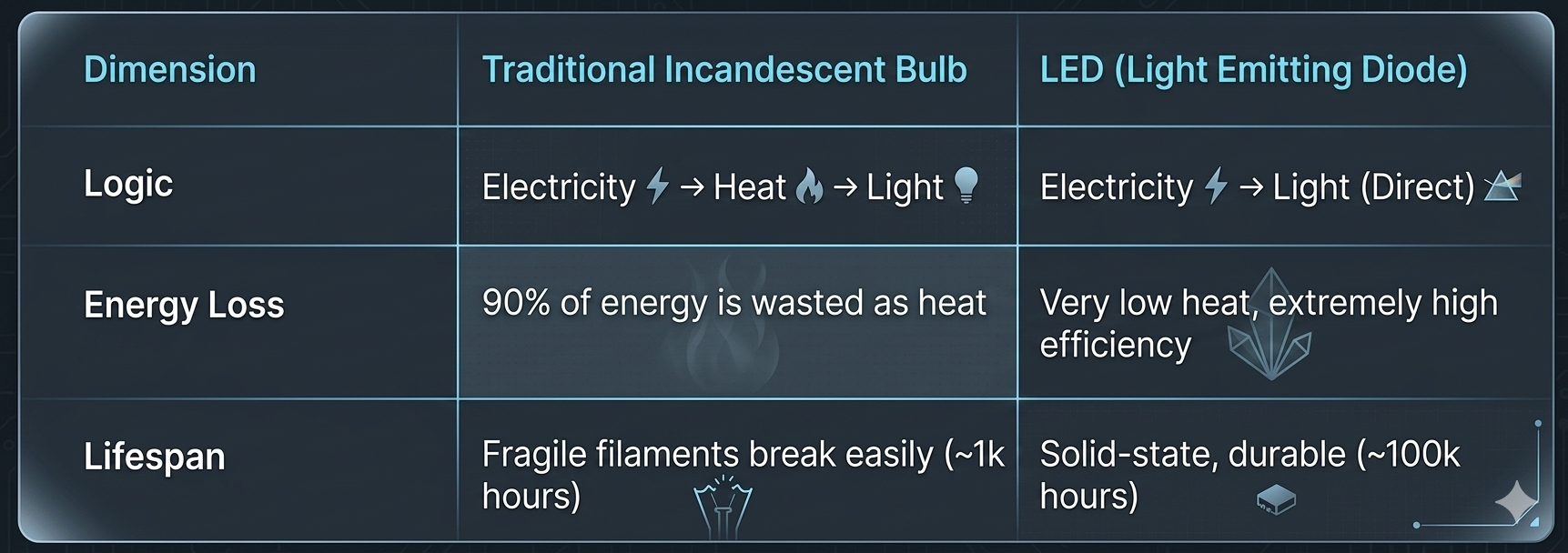
V. Summary
The working principle of an LED can be summarized as: Driven by an electric field, electrons and holes "hold hands" within a semiconductor and release their excess energy as light.
It is this direct, efficient, and controllable way of emitting light that makes LED the cornerstone of modern commercial displays, from fine-pitch LED walls to smart tabletop signage.
Want to know how LED technology can be applied to your specific project?
Don’t get bogged down by complex physical parameters. If you are looking for the perfect display solution, fill out the "Let's Talk" contact form below with your application (indoor/outdoor) and budget requirements. Our expert team will provide a tailored selection proposal within 24 hours!