


6,000m² Factory & Production Base | 400+ Classic Case Studies | 85+ Patent Certificates | 1,000+ Projects Worldwide |
Walk through any major supermarket chain today and you'll still see paper price tags on almost every shelf edge. Thousands of them. Each one printed, cut, and manually placed by a staff member. Each one wrong the moment a price changes. For retail chains managing hundreds of SKUs across dozens of locations, that paper system isn't just slow — it's expensive. Shelf screen manufacturer solutions have emerged as the hardware answer to this problem. Every major shelf screen manufacturer now offers retail digital signage that updates in real time, runs promotions automatically, and pays for itself faster than most procurement teams expect. The question is no longer whether retail digital signage works — the data is clear. The question is how quickly your chain moves.
This article breaks down the real cost comparison between traditional price tags and shelf screens, with data from retail deployments. Whether you are evaluating a shelf screen manufacturer for the first time or comparing retail digital signage suppliers for a chain-wide rollout, the numbers below apply directly to your decision.
32% avg sales lift from retail digital signage (Mvix) | 400x more views vs static signage (Intel eye-tracking) | $5.89B retail digital signage market size in 2025 (Mordor Intelligence) | 19% higher impulse purchase likelihood with digital displays (Gitnux) |
Every shelf screen manufacturer will tell you their hardware pays for itself. The honest ones show the math. Below is the framework any retail digital signage buyer can use to verify that claim independently.
The Hidden Cost of Paper Price Tags
Most retail finance teams track the cost of paper labels as a line item: printing supplies, label stock, perhaps a printer lease. That number looks small. What it misses is the labor. Traditional paper tags are the single biggest operational inefficiency that retail digital signage solves — not by being a technology upgrade, but by eliminating a recurring manual process entirely.
A mid-size supermarket with 8,000 SKUs might run promotions twice a week. Each promotion cycle requires pulling old tags, printing new ones, and re-labeling shelves — a process that takes store staff hours per cycle, per location. Scale that across 50 stores and the labor cost becomes substantial. Add in the error rate: mislabeled shelves create compliance exposure in markets with strict pricing regulations, and customer trust erodes when the price at the shelf doesn't match the register.
There's also the waste factor. Paper tag programs generate significant print waste annually. For retail chains with sustainability commitments, this is an increasingly visible problem in ESG reporting.
Where the Real Costs Accumulate
• Labor: Staff time for tag replacement across every promotion cycle
• Errors: Pricing mismatches that trigger regulatory fines or customer complaints
• Print supplies: Paper, ink, and printer maintenance at scale
• Speed: Price changes that take days to propagate across a chain instead of minutes
• Missed revenue: Promotions that can't react to inventory, time-of-day, or competitor pricing
Switching from paper tags to a shelf screen manufacturer's hardware is not just a technology upgrade — it is a reclassification of labor. The staff hours spent on price-tag management become hours spent on customer service, restocking, and floor operations. And the retail digital signage system handles every price change, every promotion, and every time-sensitive discount from a single CMS dashboard.
What Shelf Screens Actually Do
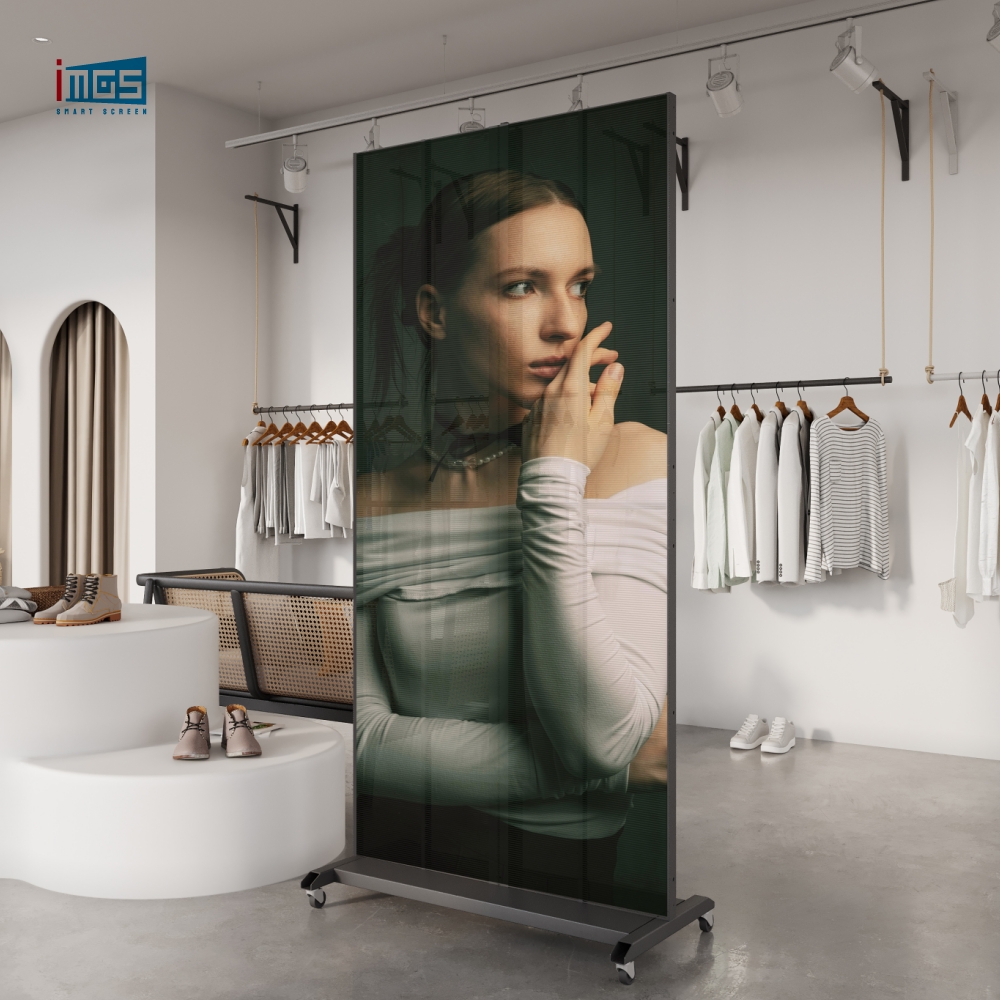
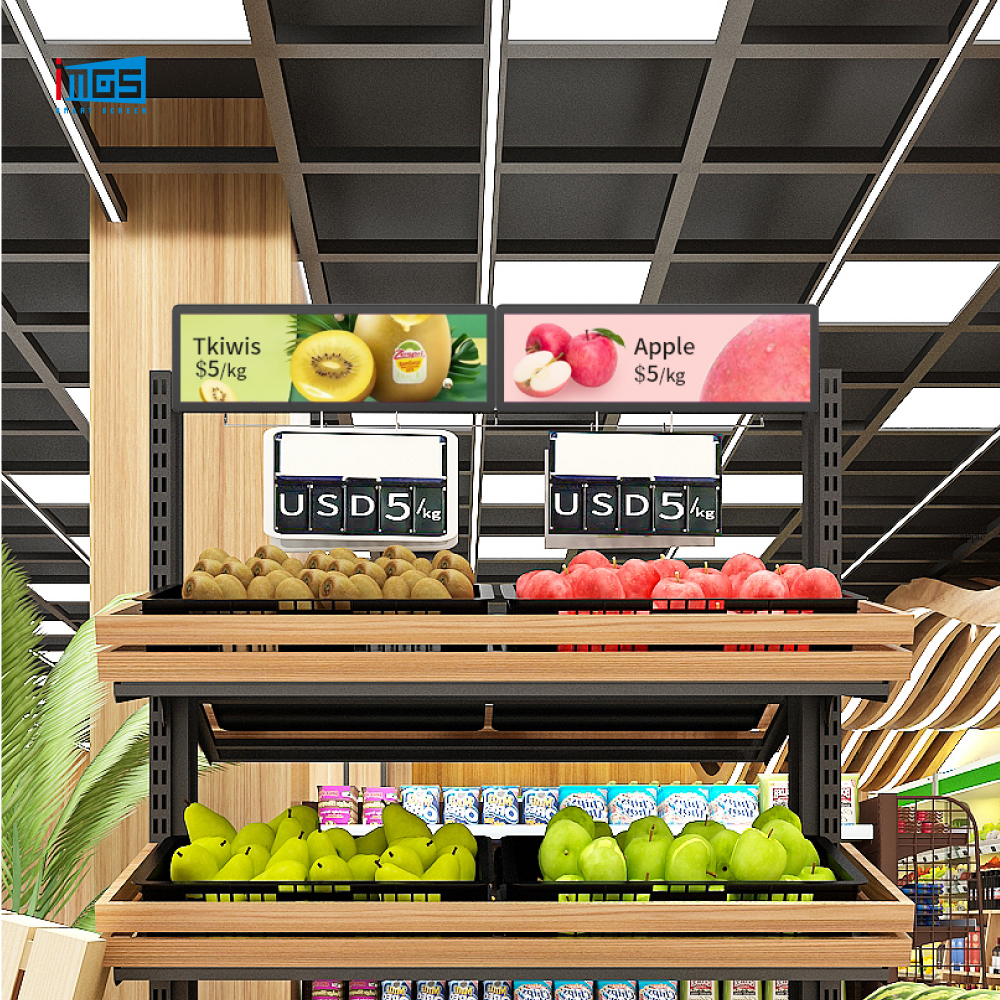
A shelf screen is a small LCD or e-ink display mounted at shelf edge, connected via WiFi or a retail network, and managed from a central content management system. It is the most targeted form of retail digital signage available — placed exactly where purchase decisions happen. The basic version shows price and product information. A capable shelf screen manufacturer builds units that run video content, display promotional graphics, integrate with inventory systems, and push updates across an entire store network in under a minute. When evaluating shelf screen manufacturer options, the hardware capability gap between budget units and purpose-built retail displays is significant.
As a shelf screen manufacturer with over 85 patents and 400+ retail deployments, iMGS builds these displays for the demands of high-traffic retail environments: high brightness for well-lit aisles, robust enclosures that survive daily cleaning, and content systems that non-technical store staff can actually use.
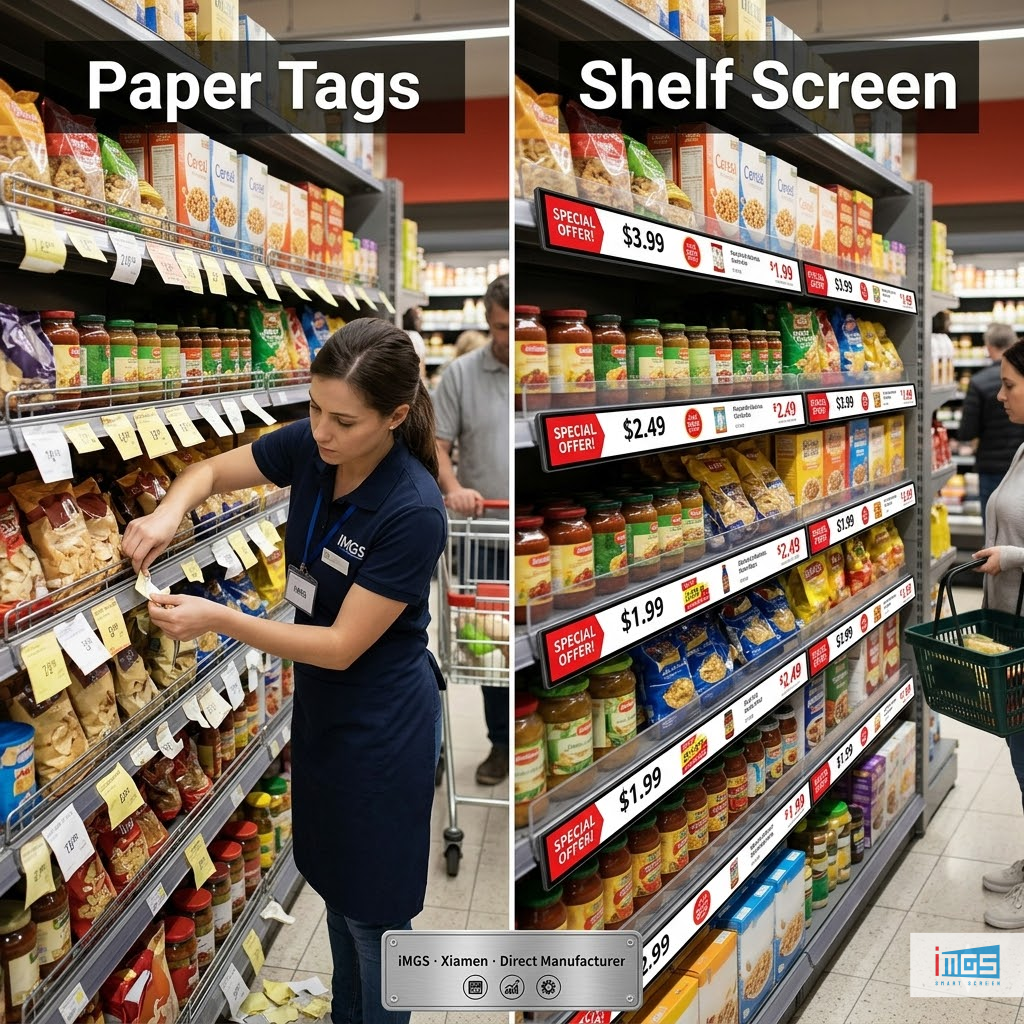
iMGS Shelf Screen — Retail Display Series Purpose-built for supermarket and retail chain deployment. Supports real-time price updates, promotional video content, and central CMS management across multiple locations. |
ROI: Where the Numbers Come From
Case Study 1: European Grocery Chain — Labor Savings at Scale
A European grocery chain with 60 locations replaced paper shelf labels with digital shelf screens across its fresh food and promotional aisles. Before the switch, price updates required an average of 14 staff-hours per store per week. After deployment, that dropped to under 2 hours — the time needed to review and approve CMS updates. Across 60 stores, that freed up roughly 720 labor hours per week, which the chain redirected to customer service and restocking. The payback period on the hardware investment was under 18 months.
Case Study 2: Walmart's Shelf Signage Network
Walmart operates approximately 170,000 in-aisle screens across 4,300 U.S. stores, according to Astute Analytica. The scale makes individual ROI calculations complex, but the strategic logic is clear: retail digital signage — the largest retail digital signage network in the world — allows real-time price response to competitor changes, time-of-day promotions, and inventory-level discounts. None of which are possible with printed tags. A 2025 study tracking 30 million shopper visits via RFID carts confirmed that digital shelf displays drive 8.1% higher purchase likelihood for featured SKUs, with 87.7% of additional revenue directly tied to digital display exposure.
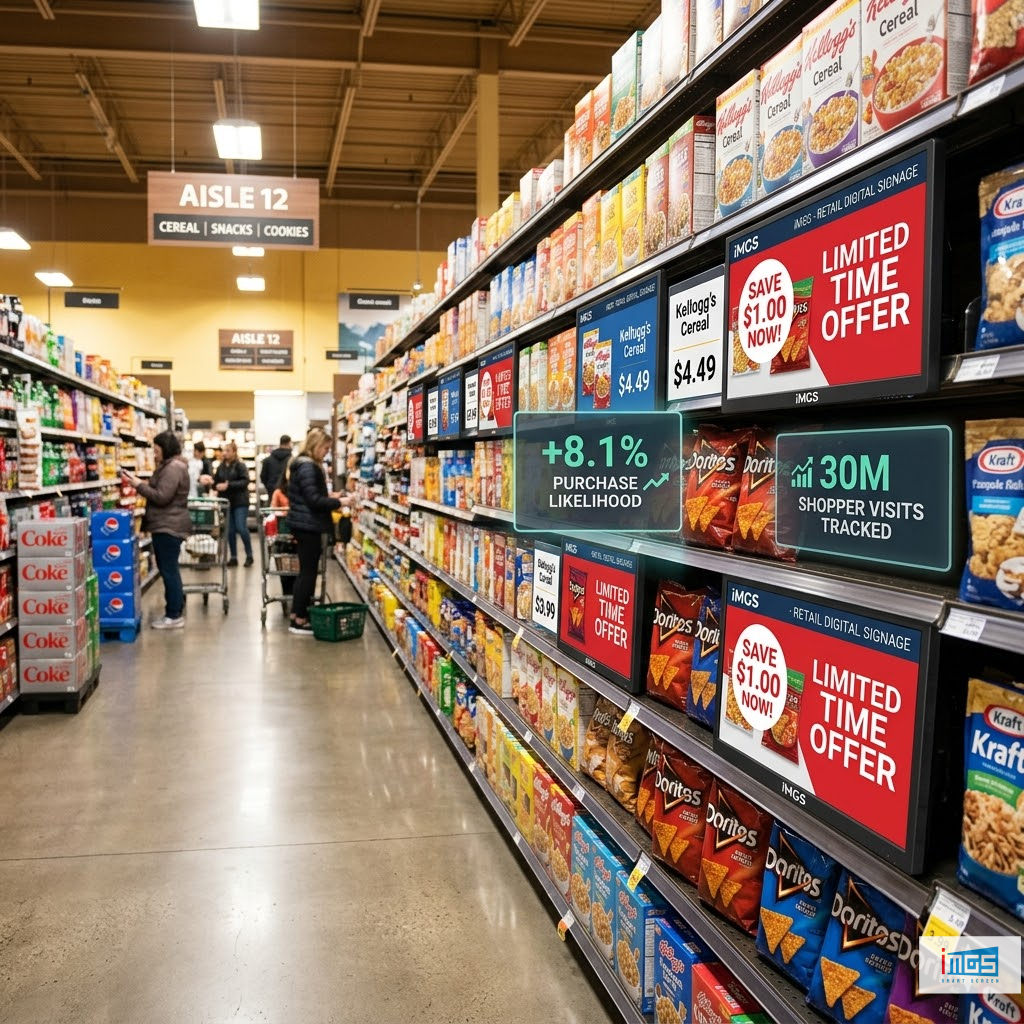
8.1% higher purchase likelihood for featured SKUs (RFID study, 2025) | 30% daily sales lift for chains using AI-integrated shelf displays (Mordor Intelligence) | 18mo typical payback period for shelf screen hardware investment | 83% message recall rate for digital vs static shelf signage (SeenLabs) |
The Shelf Screen vs Paper Tag Cost Model
The comparison isn't simply hardware cost vs print cost. A complete model needs to include:
• Year 1 hardware cost (shelf screen units + installation) vs ongoing annual print and labor cost
• Revenue uplift from dynamic promotions and real-time pricing
• Compliance cost reduction from eliminated mislabeling incidents
• Retail media network revenue — shelf screens can carry supplier ad content, generating income
For a chain with 50+ locations running frequent promotions, the break-even typically lands between 12 and 24 months. Beyond that, the shelf screen system is generating net savings every month while paper tag programs continue to accrue the same costs indefinitely.
Why Source from a Shelf Screen Manufacturer Directly
Procurement teams often start by looking at distributors or regional resellers. The markup at those layers is real — typically 20–40% above factory pricing. Buying direct from a shelf screen manufacturer like iMGS removes that layer entirely.
iMGS operates a 6,000m² production facility in Xiamen, China, with 100% factory testing on every unit before shipment. OEM and ODM options are available for chains that want branded hardware or custom screen dimensions. As a retail digital signage hardware supplier, iMGS covers the full range: shelf screens for aisle pricing, interactive displays for end-caps, and large-format retail digital signage for entrance and feature zones. With 85+ patents and 1,000+ projects delivered globally, the engineering depth is there to handle non-standard requirements.
For retail chains sourcing at volume, factory-direct pricing makes the shelf screen ROI case significantly stronger. It also simplifies warranty and support — one point of contact rather than navigating distributor and manufacturer relationships separately.
iMGS Desktop Digital Signage — Counter & Shelf Display Compact display units for shelf-edge and counter applications. High brightness, slim profile, central CMS management. Available in multiple sizes for different retail environments. |
What to Look for When Evaluating Shelf Screens
Not all shelf screen hardware performs equally in retail environments. These are the specifications that matter:
Brightness
Retail aisles are brightly lit. Retail digital signage for shelf applications needs at least 400 nits of brightness to remain readable under store lighting. Screens designed for office environments will wash out and require replacement — a cost that erases any short-term hardware saving.
Connectivity
WiFi is standard, but retail environments with metal shelving can create dead zones. Look for hardware with reliable signal performance and failover options. Some manufacturers offer PoE (Power over Ethernet) variants that eliminate the need for separate power runs. Network reliability directly affects whether your retail digital signage system updates in seconds or in hours — the difference matters when you are running time-sensitive promotions.
Content Management
The CMS is where the ROI lives. A shelf screen manufacturer that builds its own CMS — or integrates cleanly with retail ERP systems — reduces the friction of price updates. Look for bulk update capability, scheduling, and multi-location management from a single dashboard. The best retail digital signage systems let store managers approve content on a tablet while the CMS pushes updates chain-wide automatically.
Durability
Shelf screens get bumped, cleaned, and exposed to moisture in produce and refrigerated sections. IP-rated enclosures and impact-resistant screens are not optional for grocery environments. Ask any shelf screen manufacturer for MTBF data and warranty terms specific to retail environments — these vary significantly across suppliers.
iMGS Interactive Advertising Display — 75" Retail Format Large-format interactive display for retail end-caps and feature displays. Touch-enabled, high brightness, supports real-time promotional content. |
Making the Business Case Internally
For procurement and operations teams building an internal case for retail digital signage at shelf level, the structure is straightforward. The numbers work for chains of all sizes, but the ROI accelerates with store count — the labor saving compounds across every location.
• Baseline the current cost: Calculate annual print + labor across all locations — this is what retail digital signage replaces
• Get a hardware quote: Direct from a shelf screen manufacturer to remove distributor margin — a shelf screen manufacturer selling factory-direct typically saves chains 20–40% vs reseller pricing
• Model the labor saving: Conservative estimate is 80% reduction in price-change labor
• Add revenue uplift: Retail digital signage deployments show 8–30% sales lift on promoted SKUs across documented case studies
• Calculate payback period: Most chains land between 12 and 24 months at volume
The retail digital signage market is projected to grow from $5.89 billion in 2025 to $7.86 billion by 2030, according to Mordor Intelligence. The chains moving now are building the operational infrastructure and supplier relationships ahead of that curve. Those that wait are paying the same paper tag costs every year while competitors gain pricing agility and shelf-level media revenue.
iMGS is a shelf screen manufacturer built for B2B retail buyers. Every shelf screen manufacturer on the market will quote hardware. iMGS also provides OEM/ODM options, factory-direct pricing, and the engineering support to deploy retail digital signage at chain scale. Contact the team directly to get a quote matched to your store configuration and volume.
Ready to Switch to Shelf Screens? Get a direct quote from iMGS — manufacturer pricing, OEM/ODM available, global shipping. Email: irenepan@fj-imgs.com | Phone: +86-18850151946 |