


London Underground Smart Advertising Displays: AI-Powered Content Adaptation Based on Passenger Emotions
6,000m² Factory | 400+ Cases | 85+ Patents | 1,000+ Projects |
Walk through Oxford Circus station on a Tuesday morning and you will notice something that was not there five years ago: an interactive advertising display that notices you back. The smart advertising displays now lining the platforms and concourses of London Underground do more than cycle through pre-loaded ads. They read the room — detecting passenger mood, adjusting content in under half a second, and delivering messages that land because they match the moment. This article breaks down how the technology works, what the market data says, and what hardware buyers need to understand before specifying a system.
$18.7B | Global smart advertising display market in 2023 (OutSmart) | 35%+ | Share held by transportation hubs |
23.4% | Annual growth rate for the sector | 31.2% | CAGR of AI-enabled interactive devices |
Why Emotion-Responsive Displays Work in Transit Environments
The smart advertising display category has matured from simple digital posters into context-aware platforms. The interactive advertising display variant — which reads the audience and responds — is where the category is heading fastest.
An interactive advertising display in a transit environment works on a simple premise. Transit passengers sit in a uniquely predictable emotional state. Commuters are routine-driven; they know the route, the timing, and the wait. Leisure travellers are curious and often plan-making in their heads. Both groups have dwell time — measured in minutes, not seconds — and no competing screens in their hands if the content on the wall is interesting enough.
According to TechAnalysis research, smart advertising displays with emotion recognition technology increase advertising message reach by 47% and raise brand engagement by 3.2 times compared with static or non-adaptive digital panels. The London Underground deployments show why: the system detects the emotional state of up to 15 passengers simultaneously and updates content within 0.5 seconds. Tired faces at 7:30 AM get different copy than the lunch crowd heading to Carnaby Street.
This is the core argument for emotion-aware smart advertising displays: the same screen real estate, the same electricity bill, but a message that fits the audience standing in front of it right now.
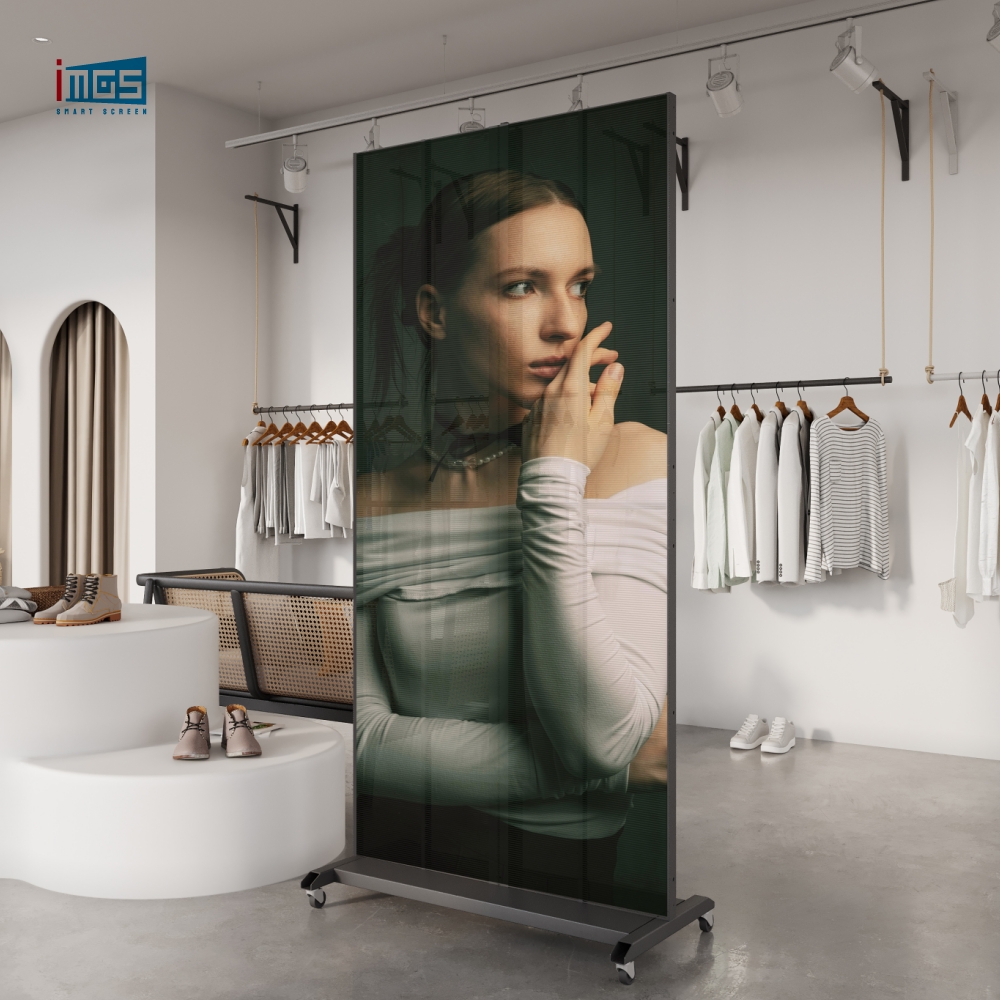
Product: Interactive Advertising Display 75-inch interactive screen with AI-capable processing, 4K resolution, and commercial-grade touch — built for high-traffic transit and retail environments. |
Core Technology: What the Hardware Must Deliver
Specifying an interactive advertising display for a transit environment is not a software problem alone. The hardware has to keep up. There are four metrics that matter to buyers specifying these systems:
Recognition accuracy at 98.5% and response time under 0.3 seconds are the two specifications that separate viable deployments from pilots that get quietly shelved. At 98.5%, false positives are rare enough that mismatched content (showing a coffee ad to someone who just scowled) happens less than twice in every hundred impressions. At 0.3 seconds, the content switch is invisible to the passenger — it feels contextual, not mechanical.
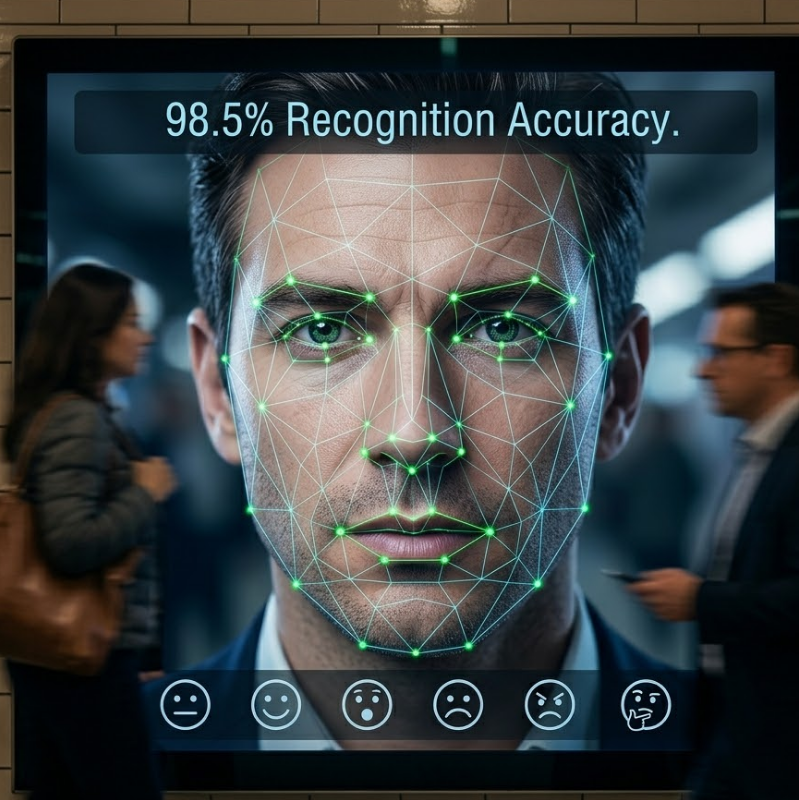
For an interactive advertising display to perform at this level, the content management layer requires over 500 preset scenarios and a deep learning neural network that achieves 92% content matching accuracy. That figure matters because the AI must match emotion type, time of day, passenger density, and campaign rules simultaneously. A single-layer rule engine cannot do this reliably.
Concurrent processing for up to 15 people means the interactive advertising display handles peak platform loads without queuing delays. Buyers should ask vendors for documented stress-test data at this threshold, not just peak-lab numbers.
Product: Digital Signage iMGS commercial digital signage range — engineered for 24/7 operation, available in single-sided and dual-sided configurations for platform and concourse use. |
Two Brand Deployments That Show the Numbers
McDonald's: 45,000 Locations, $20M in Annual Savings
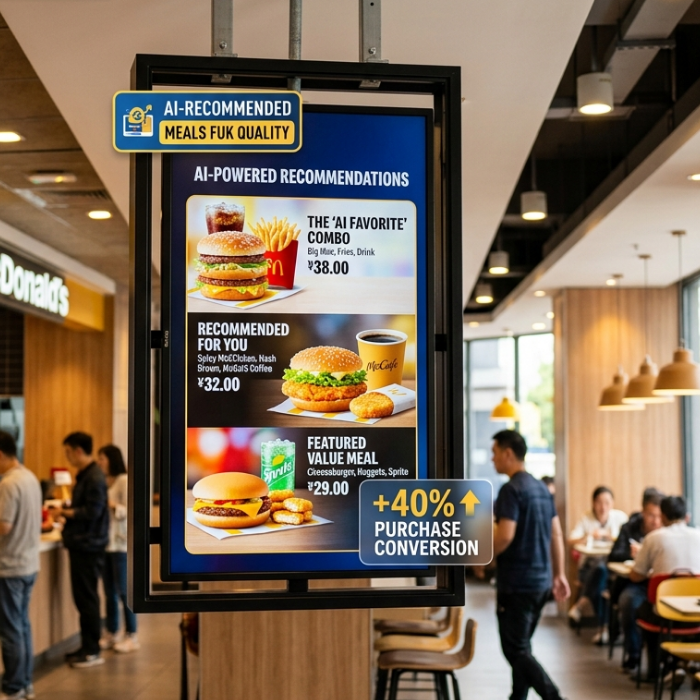
McDonald's deployed smart advertising displays across 45,000 locations worldwide. The system recommends menu items based on customer expressions at the point of order. The result: immediate purchase conversion increased by 40%, and the chain saves over $20 million per year that previously went to traditional menu board printing and static panel updates. The ROI case closed itself — the hardware pays back through margin improvement, not just branding value.
Nike Oxford Street: 2.3× Longer Dwell Time
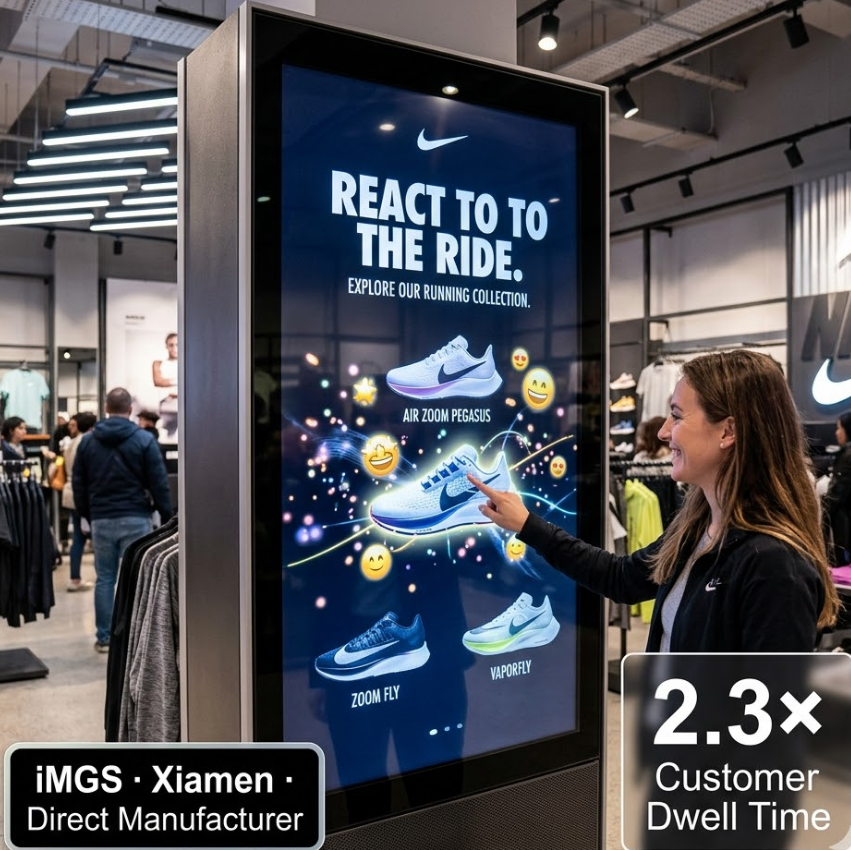
Nike's London Oxford Street flagship installed interactive advertising displays that recommend sports collections based on detected customer emotions. Customer dwell time increased by 2.3 times. For a flagship store where floor time directly correlates with purchase likelihood, that metric is more valuable than any single campaign uplift figure. The interactive advertising display does not push a product; it opens a conversation that customers choose to continue.
Product: Dual Sided Advertising Screen Double-sided smart advertising display for high-footfall corridors — captures traffic from both directions, ideal for Underground passages and retail malls. |
What Buyers Get Wrong When Specifying These Systems
Most specification errors for smart advertising displays happen at the hardware layer, not the software layer. Buyers often accept a vendor's AI chip generation claim without checking the benchmark. Third-generation AI chips or newer are the minimum for the latency and concurrent processing figures described above. Older chipsets can run the recognition model but cannot sustain sub-0.3-second response under full passenger load.
The second common error buyers make when procuring an interactive advertising display is treating content management usability as a nice-to-have. The advertising teams who update campaign content are not AV engineers. If the CMS requires a specialist to add a new scenario preset, the 500-preset library becomes a 50-preset library in practice, and the system underperforms its specification.
Third: after-sales support. For any interactive advertising display running in a transit environment, a 24/7 support SLA is not standard across the market. A screen outage during peak commute hours is not an inconvenience — it is a contract breach with the concession operator. Verify the support commitment before signing, not after.
Finally, data compliance. Any interactive advertising display using emotion recognition processes biometric data. In the UK and EU, this falls under GDPR. Any deployment must include documented data minimisation protocols, anonymisation at the edge (the device, not the cloud), and a clear retention policy. This is a hardware and architecture question as much as a legal one.
Product: Floor Standing Kiosk Freestanding smart advertising display for open concourse areas — commercial-grade enclosure, adjustable orientation, suitable for indoor transit and retail zones. |
Why Hardware Buyers Source from iMGS
iMGS is a digital signage manufacturer based in Xiamen, China, with a 6,000m² production facility, 85+ patent certificates, and over 1,000 completed projects across more than 40 countries. Every unit ships after 100% factory testing. There are no distribution markups: buyers deal directly with the factory, which means the lead time, pricing, and specification conversations happen with engineers, not account managers.
For buyers specifying smart advertising displays in transit or retail environments, iMGS offers OEM and ODM programmes. If your deployment requires custom enclosure dimensions for a specific platform recess, or a proprietary bezel design for a branded concession, the factory handles that without subcontracting. The 85+ patents cover display mechanics, thermal management, and AI processing integration — the kind of IP that only accumulates in a manufacturing operation that has been building display hardware at scale for years.
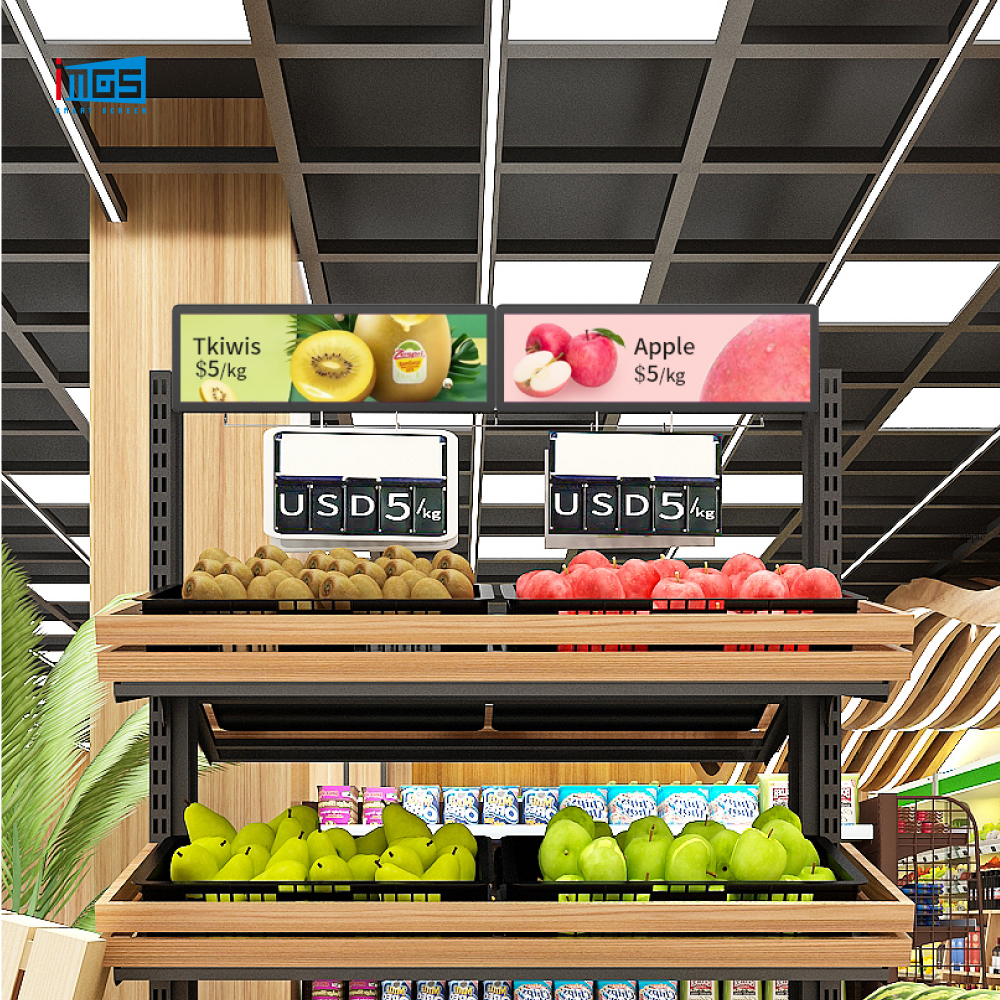
The product range covers the full specification map for transit deployments: single-sided and dual sided advertising screens for corridor installations, interactive advertising displays for dwell zones, and ceiling mounted digital menu boards for F&B concessions inside stations. All panels are specified for commercial 24/7 operation. Contact the team at irenepan@fj-imgs.com or +86-18850151946 to discuss your project.
Conclusion
The London Underground deployment is not a novelty project. It is a production system running at scale in one of the world's busiest transit networks, delivering measurable uplift in message reach and brand engagement. The technology is ready. The market is growing at 23.4% annually and will exceed $28 billion by 2025. The question for brands, system integrators, and AV distributors is not whether to deploy smart advertising displays or which interactive advertising display format to prioritise — it is which hardware partner has the manufacturing depth to back the specification.
Buyers who want to evaluate options without the distributor layer should request a live demo directly from the iMGS factory team.
Ready to Deploy Smart Advertising Displays? iMGS is a direct manufacturer with 85+ patents, 400+ deployments, and full OEM/ODM support. Talk to our hardware team today. Email: irenepan@fj-imgs.com | Phone: +86-18850151946 |