

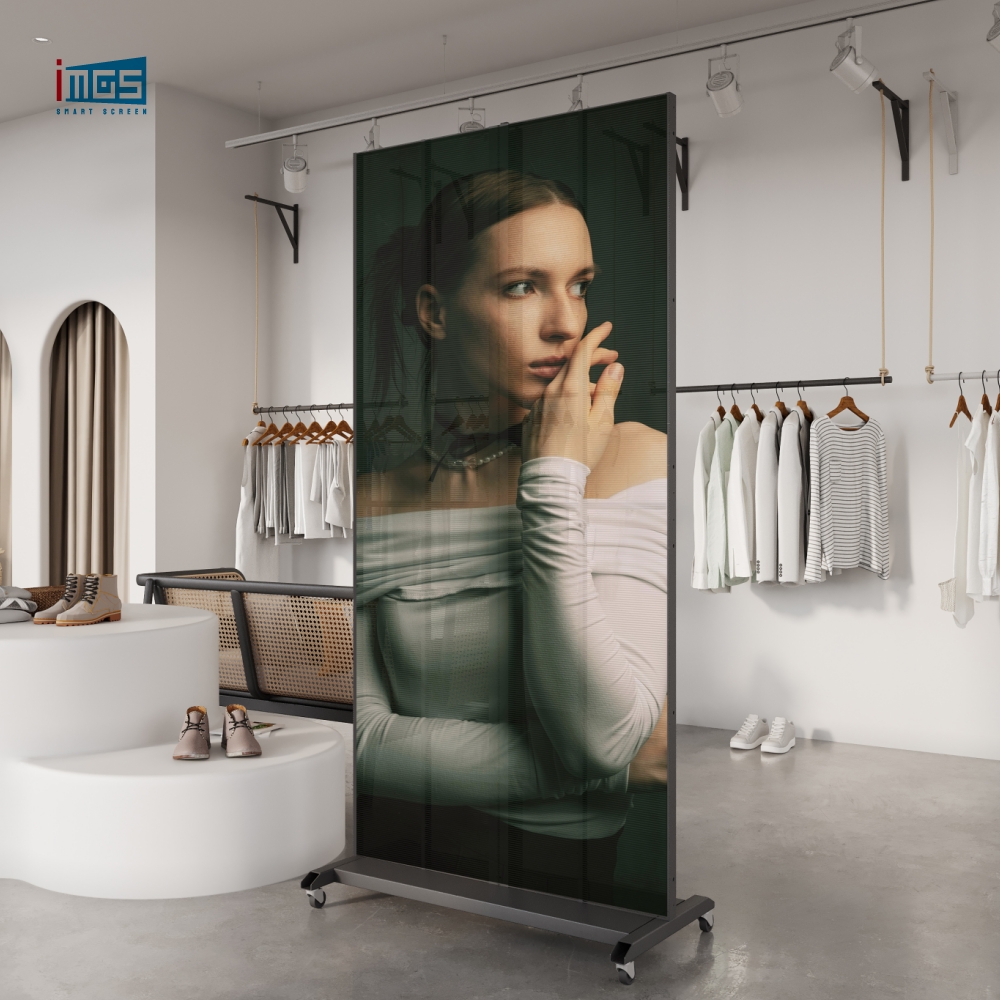
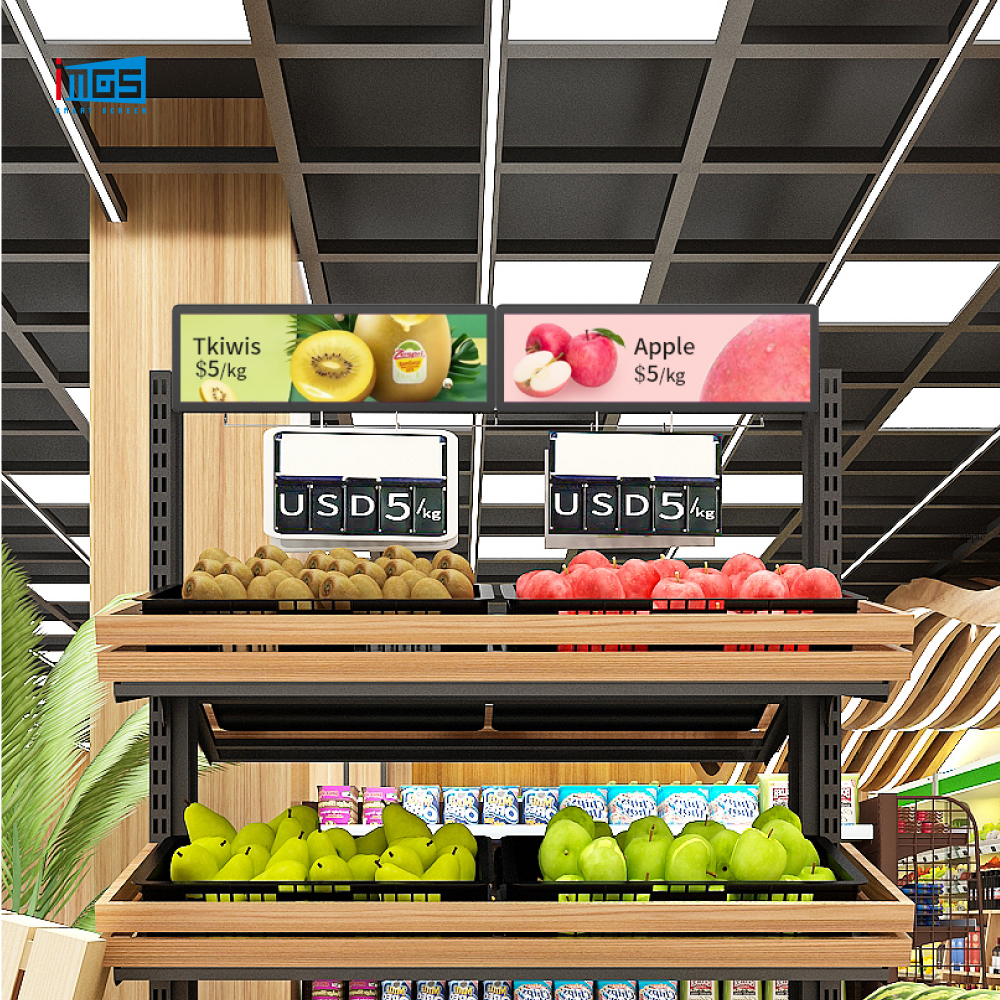

In Snow White, the magic mirror that could answer the question "Who is the fairest of them all?" was once a fantasy in a fairy tale.
Today, a brand-new "magic mirror" has quietly stepped into reality. It no longer judges beauty or ugliness, but intervenes in our lives in a more profound way—it stands in shopping malls, brand stores and beauty counters, interacting with everyone who passes by. This is the magic mirror screen.
Part 1: The Digital Awakening of a Mirror
As a tool for people to reflect on themselves, a mirror's main function is reflection. When light arrives and an image appears, its mission is completed.
The emergence of the magic mirror screen is a digital reconstruction of this ancient object, turning it into a screen interface in the form of a mirror surface.
A Mirror That Speaks
Simply put, the magic mirror screen perfectly integrates a high-definition display screen into a mirror through precision optical coating technology, achieving a true integration of mirror and screen.
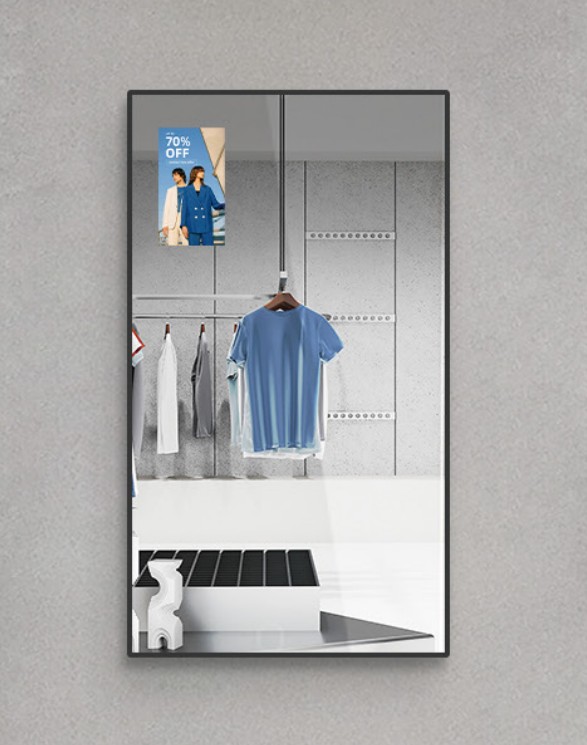
The flexibility of the magic mirror screen lies in its switchable states. When the screen is on standby, it is no different from an ordinary mirror, allowing users to tidy their appearance and attire in front of it.
When it is activated, digital content penetrates the mirror layer and is clearly displayed in front of the user. The integrated touch, voice or gesture interaction modules are also activated in an instant, able to respond to the user's instructions.
One Mirror, Two Dimensions
In retail spaces, the magic mirror screen resolves the contradiction between functionality and aesthetics. There is no need to place a mirror and an advertising screen side by side separately; a single magic mirror screen meets both needs, making store furnishings more concise.
At the same time, the user's experience flow is not interrupted by hardware switching. From looking in the mirror to obtaining information, it is a continuous process, and the interaction intention is naturally connected.
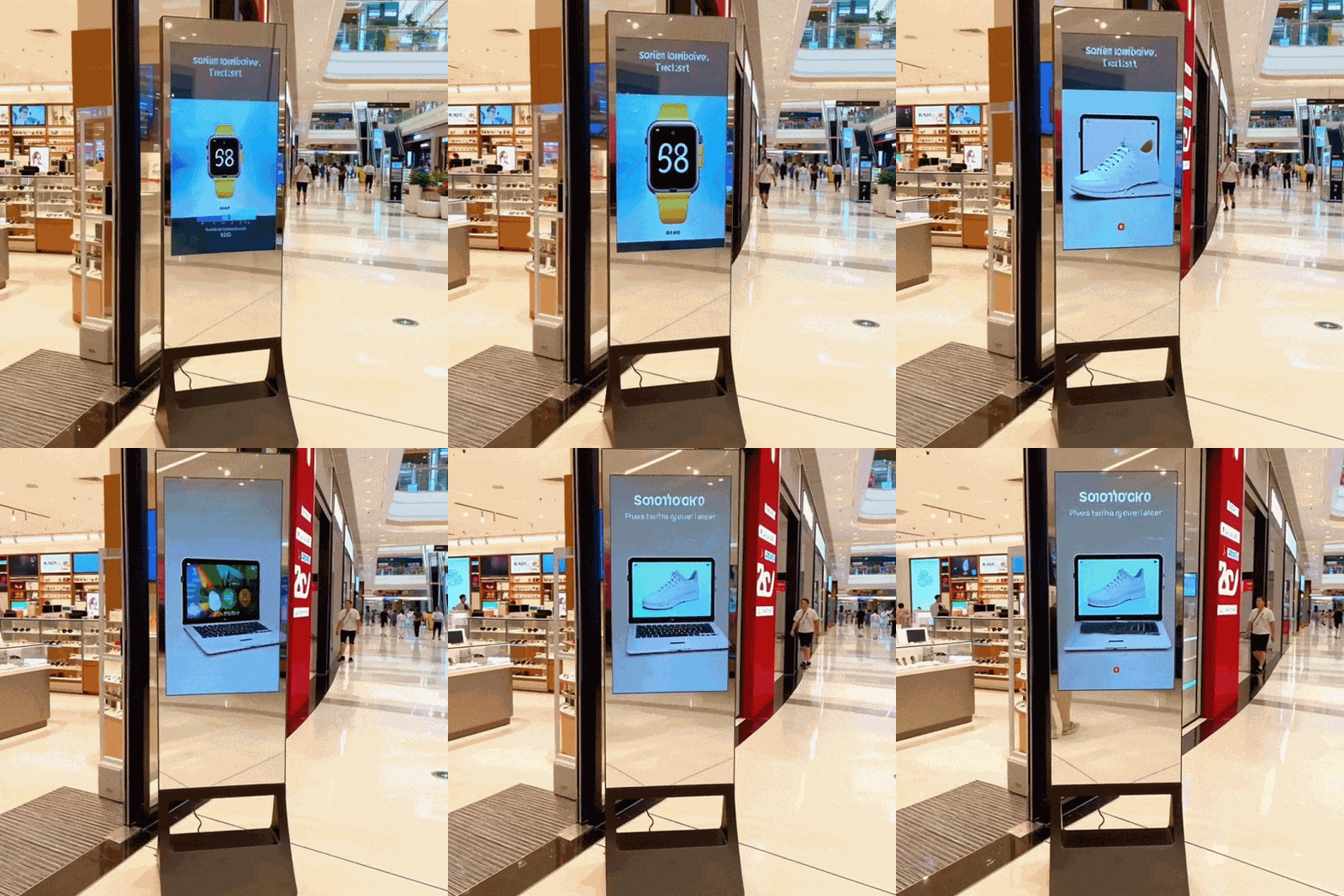
◎ The iMGS magic mirror screen automatically switches between mirror and advertising screen through intelligent induction.
If a traditional mirror provides a one-way reflection, the magic mirror screen constructs a two-way interface. It still reflects images, but at the same time, it is a window: through this mirror layer, the digital space is seamlessly superimposed on the field of vision.
Part 2: The "Space-Time Folding" of the Mirror
The structure of a magic mirror screen itself is not complicated; it can be disassembled into a system where the display layer, perception layer and control layer work together.
Display Layer: Mirror in Front, Screen in Back, Symbiosis of Two Layers
The display layer is the physical foundation of the magic mirror screen, mostly adopting a structure of mirror in front and screen in back: a piece of semi-transparent and semi-reflective optical coated glass is placed in the front, and a liquid crystal display screen is placed in the back.
Through special optical processing, the mirror reflects real human figures, and the screen transmits digital information. On the same interface, real images and digital content are superimposed on each other, forming a seamless "screen in mirror" effect.
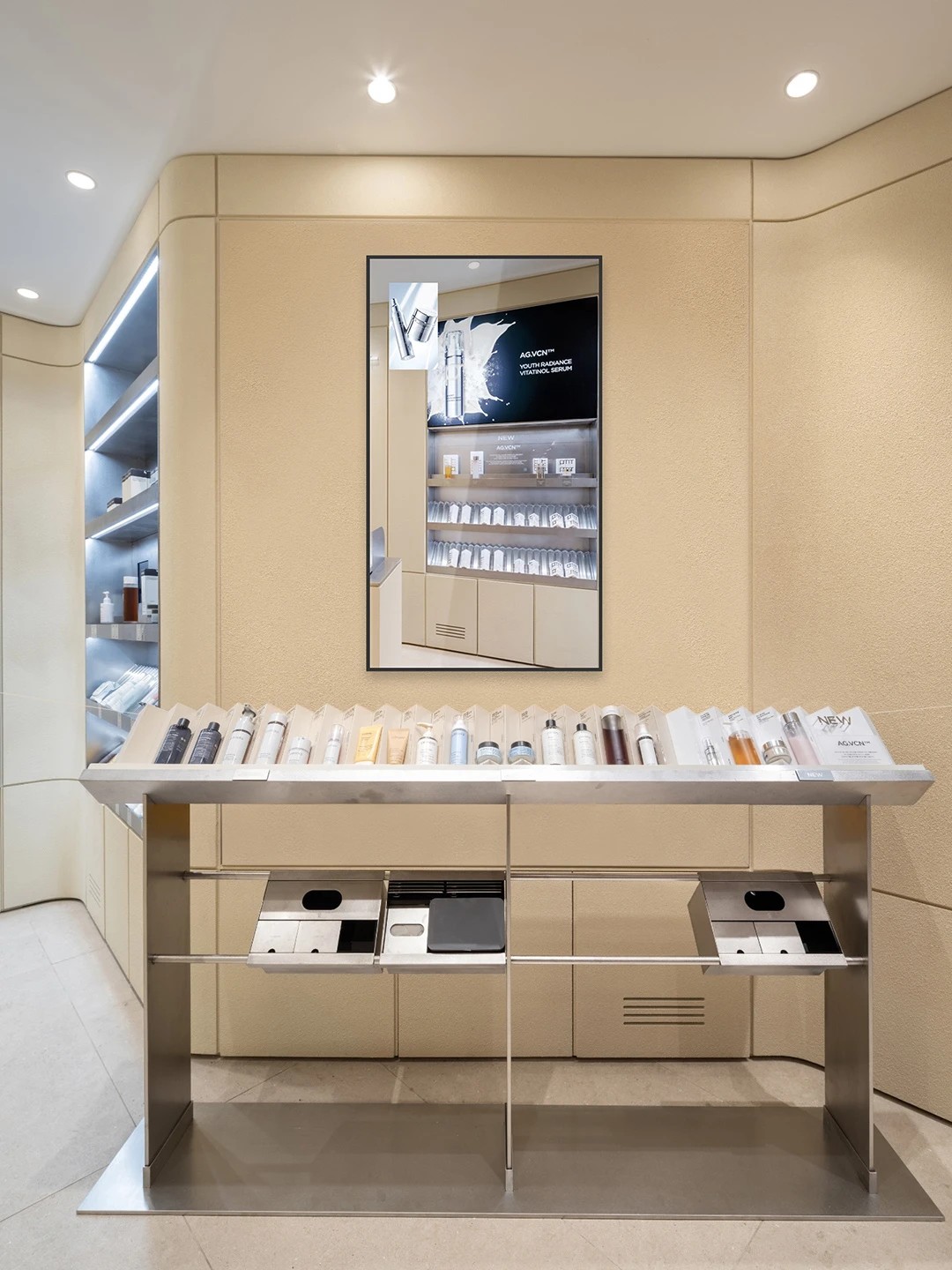
◎ The iMGS magic mirror screen reflects real images while allowing the backlight information of the screen to penetrate the mirror surface for superimposed display.
Perception Layer: Intelligent Senses Connecting Reality
The perception layer is the starting point for realizing interaction. It consists of a series of integrated sensors and underlying recognition algorithms, capturing physical dynamics in real time and converting them into data that can be understood by the computing system.
For example, it judges user characteristics through face recognition, receives non-contact instructions through gesture recognition, obtains information about items in front of the mirror through commodity recognition, and users can also directly perform touch operations on the mirror surface to interact with the screen.
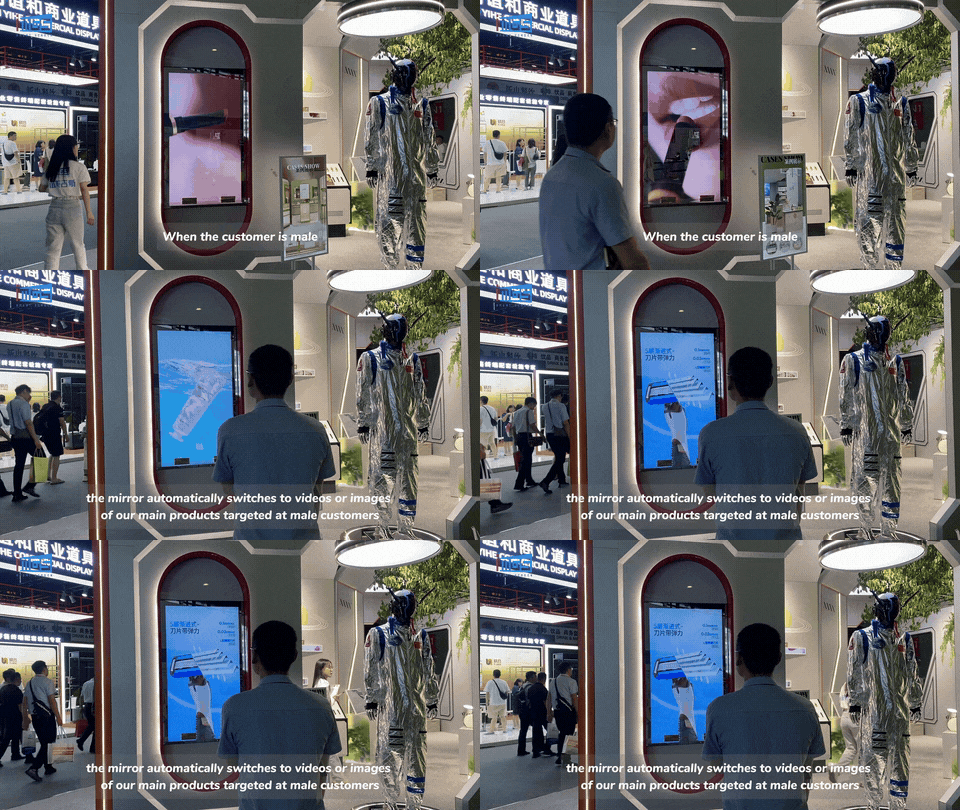
◎ The iMGS magic mirror screen has a built-in induction module. When it detects a user stopping in front of the mirror, it will automatically zoom out the advertising interface to make clear vision for the user's real mirror image.
Control Layer: Real-Time Response to Data Instructions
The control layer of the magic mirror screen is responsible for processing the data transmitted from the perception layer, or manually operating the background equipment to drive the display layer to give real-time responses. For example, running AR rendering, commodity recommendation, outfit matching, and advertising content scheduling are all realized through the control layer.
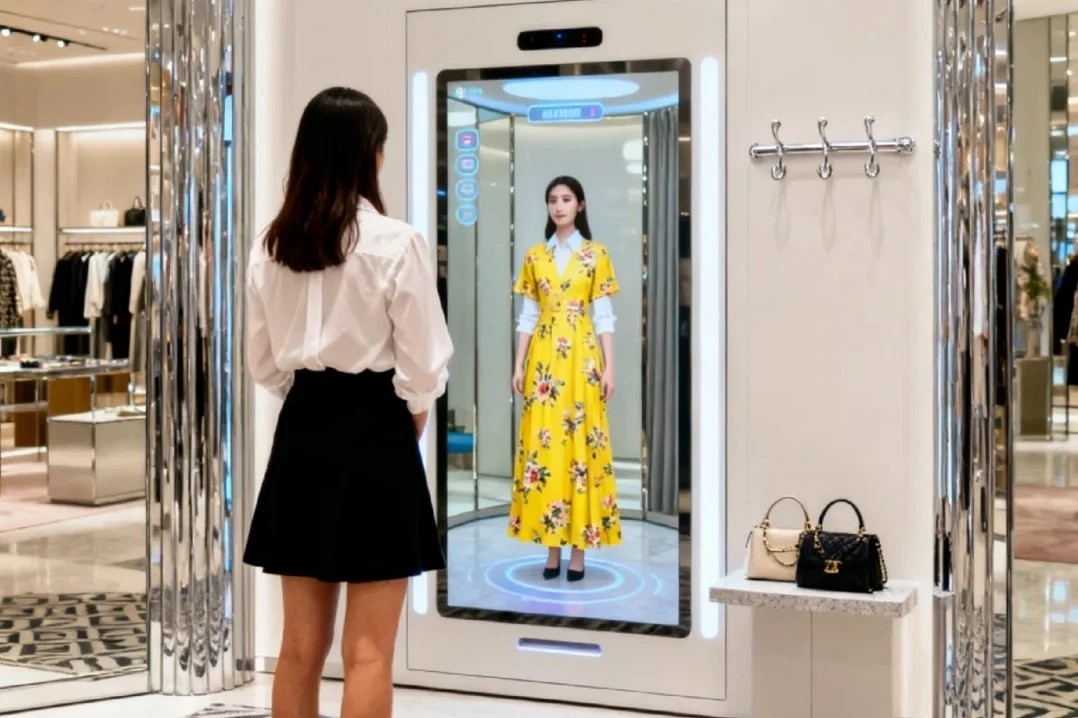
Imagine such a scenario: when a user picks up a piece of clothing and stands in front of the magic mirror screen, the perception layer instantly recognizes the person and the commodity, the control layer receives the signal, and retrieves the 3D virtual model and matching recommendations of the commodity from the cloud.
The display layer almost synchronously "puts" this virtual clothing on the user's image in the mirror, and matching suggestions and prices can also appear next to it.
It is this close system collaboration that the magic mirror screen folds a huge amount of digital information into a single mirror surface, realizing the co-frame integration of physical entities and digital space.
Part 3: A Versatile Tool Hidden in Scenarios
In retail scenarios, traditional mirrors have a single function, while the magic mirror screen can play multiple roles in sequence or simultaneously at the same physical location, becoming a versatile tool for empowering experience upgrading.
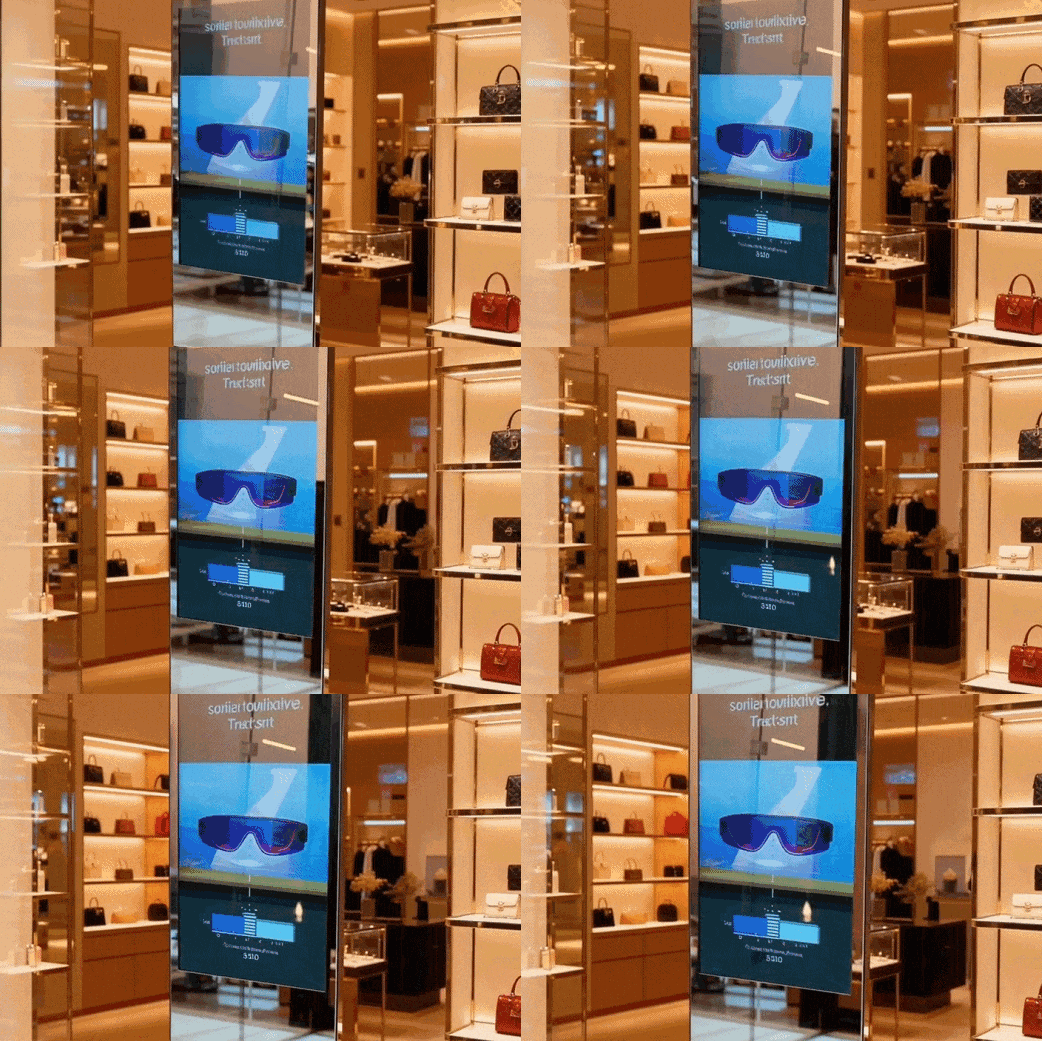
Virtual Fitting: Infinite Wardrobe, One-Click Outfit Change
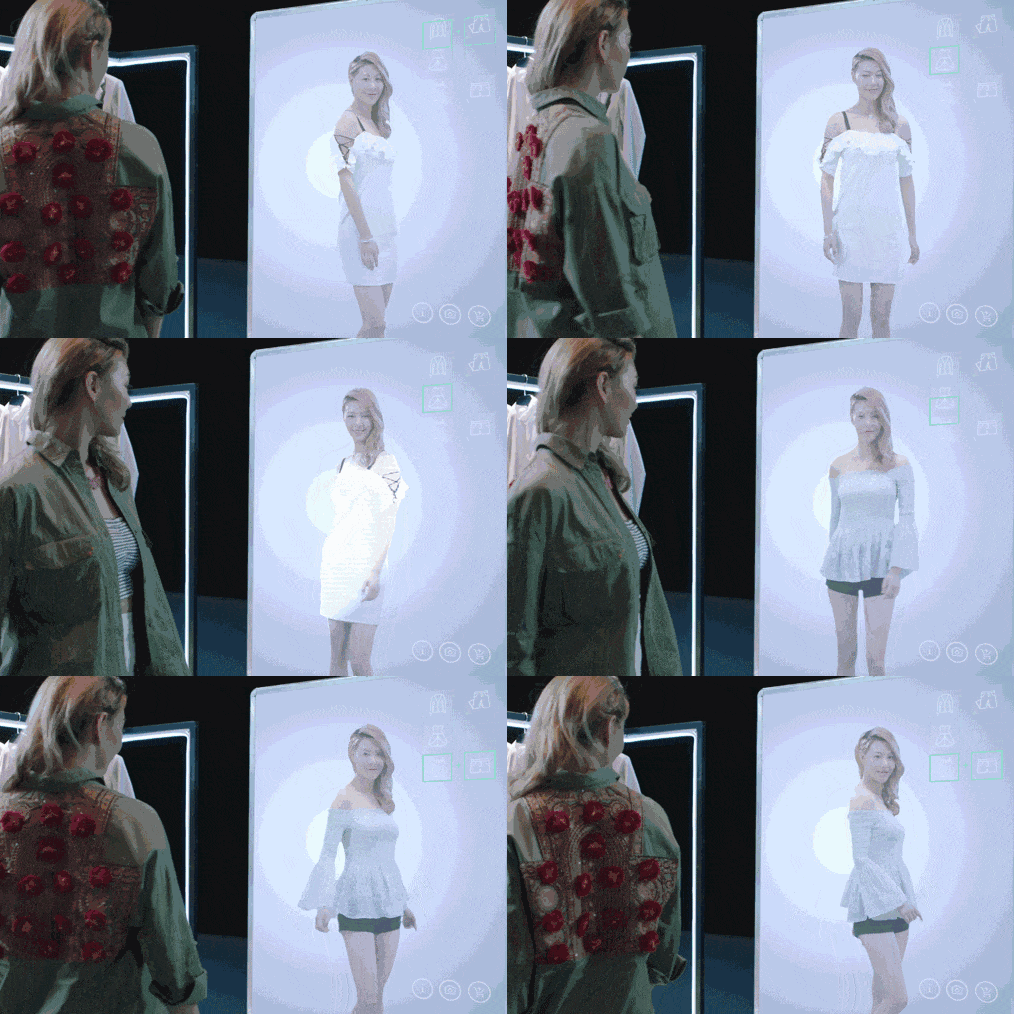
In clothing stores, the magic mirror screen can serve as an ordinary mirror for users to see the real wearing effect, and also provide users with a virtual fitting experience.
Users only need to stand in front of the magic mirror screen, and the camera can accurately capture the body outline, and preview the upper body effects of various clothes, hairstyles and accessories on the screen in real time without frequently going back and forth between the shelves and the fitting room.
Cloud Shelf: Enhanced Display of Commodity Information
Stores are limited by physical space and cannot display all SKUs. The cloud shelf function of the magic mirror screen is a breakthrough of this limitation. It no longer confines commodities to shelves, but displays an infinite product library through digital means.
Product colors, sizes, material details, matching videos and even user reviews can all be "folded" into this mirror
Interactive Experience: Gamified Experience Settings
The highest level of attraction is to make users forget that they are consuming. The magic mirror screen can gamify and socialize the shopping process through preset interactive games.
The interesting interactions created by the magic mirror screen can stimulate customers to spontaneously stay, participate and share, and naturally complete brand cognition and consumption decisions in a pleasant flow state.

Of course, a high-definition screen can realize virtual fitting, infinite shelves and interactive games, but the uniqueness of the magic mirror screen is that it has completed an exquisite scene disguise: it transforms into a mirror, integrates into the environment in the most natural and unobtrusive form, and makes technology invisible.
The magic is that the other side of the mirror is no longer an empty reflection, but an almost infinite digital world.
Whether as an interface for the integration of virtual and real, or an entrance for immersive experience, the magic mirror screen provides a more interesting path and imagination for the digital upgrading of retail fields.