



In the commercial display industry, buyers are often overwhelmed by technical jargon like "LED-backlit," "Fine-pitch," or "LCD Video Walls." The truth is, choosing the right equipment isn't just about the price tag—it’s about your application scenario.
Today, we’re stripping away the marketing buzzwords to analyze the fundamental physics of these two technologies and help you settle the "Battle of the Ls."
I. The Technical Showdown: Which One Truly "Glows"?
Many people mistake LCD and LED for similar technologies, but they function fundamentally differently at a physical level:
1. LCD (Liquid Crystal Display): The Passive "Shutter"
Think of an LCD as a window with built-in blinds.
How it works: Liquid crystals do not emit light themselves. They sit in front of a backlight (most modern LCDs use LED beads as this light source, hence "LED-backlit LCD").
Mechanism: The backlight stays on, and the liquid crystal molecules rotate to control how much light passes through, creating colors.
The Flaw: Because the "blinds" can’t close perfectly, LCDs struggle to display true black; dark areas often look slightly grayish.
2. LED (Light Emitting Diode): The Active "Pixels"
An LED screen (specifically Direct-view LED) is like millions of tiny, colored lightbulbs.
How it works: Each pixel (composed of Red, Green, and Blue diodes) is its own light source.
The Edge: When a part of the image needs to be black, the diodes simply turn off. This results in infinite contrast and massive visual impact.
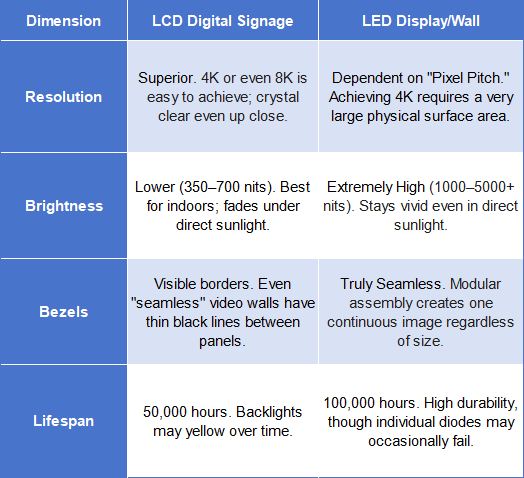
II. Key Parameter Comparison: Which Fits Your Space?
III. Case Studies: What Do the Pros Choose?
Case A: Luxury Retail Flagship Store "Facade"
Selection: Fine-Pitch LED Wall
Scenario: A luxury brand’s feature wall in a mall atrium.
The Truth: These areas are flooded with ambient light and require high visual impact to stop foot traffic. The seamless nature and high brightness of LED make advertisements look like cinematic masterpieces.
Case B: Office Building Elevator Information Screen
Selection: LCD Standalone Signage
Scenario: Narrow elevator lobbies where viewers are only 0.5 meters from the screen.
The Truth: This requires extreme text clarity. If you used LED, the viewer would see individual pixels (the "screen door effect"), and the high brightness would be jarring in a tight space. LCD’s soft, high-definition output is the perfect fit.
Case C: Outdoor Plaza "Megascreen"
Selection: Outdoor LED Display
Scenario: The exterior wall of a pedestrian shopping street.
The Truth: "Brightness" is the only metric that matters here. An LCD screen would look like a black slate against the sun. Only LED can compete with daylight while offering weatherproofing against rain and heat.
IV. The Gold Standard for Selection: A Cheat Sheet
Check the Distance: If the audience is within 2 meters, go with LCD (e.g., menu boards, elevator screens). If they are 5+ meters away, go with LED.
Check the Light: For standard indoor lighting, choose LCD. For areas with direct sunlight or semi-outdoor exposure, LED is mandatory.
Check the Content: If you are displaying heavy text or data charts (e.g., meeting rooms, control centers), LCD’s pixel density wins. If you are playing high-energy video ads, LED’s color pop and scale are unbeatable.
V. Summary
There is no "perfect" device—only the "right" solution.
LCD is the refined "Detail Master," responsible for precise, close-range communication.
LED is the flamboyant "Traffic Magnet," responsible for long-distance visual awe.
Wondering which display is the perfect fit for your project?
Don’t let complex technical specs stall your decision. Fill out the "Let's Talk" contact form below with your specific application (indoor/outdoor) and budget requirements.
Our expert team will reach out within 24 hours to provide a one-stop solution—from selection to installation. Save yourself the hassle of endless comparisons and secure your "ultimate display solution" today.