


Introduction:
The Battle Between the "Golden 60-Second Rule" and Visual Fatigue
In business psychology, there is a famous "Golden 60-Second Rule": a consumer's interest in a physical store is either established or lost within the first minute of entering, or even in the few seconds they stand at the entrance.
However, with the convenience of online shopping and the rising threshold of consumer expectations, ordinary window displays and printed posters are facing severe challenges of "visual fatigue." From the perspective of 2026, the first impression of a physical space is no longer solely determined by renovation materials (marble or wood), but is increasingly defined by "light, shadow, and interaction"—that is, smart commercial display solutions.
From a cold screen to building a "field," immersive commercial displays are becoming the shortest path to connect brand stories with consumer minds.
Case Study 1: "Emotional Resonance" in Luxury Retail — Not Selling Goods, But Creating Dreams
For high-end luxury retail, the core of the digital retail experience lies not in promotion, but in conveying "exclusivity" and "artistry."
Scenario Pain Point: Traditional static light boxes cannot carry the complex cultural narratives of luxury brands, and the cost and cycle for changing materials are high and long.
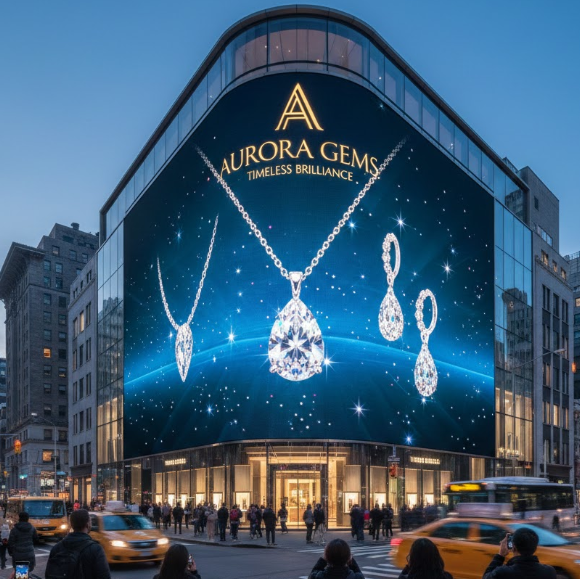
Immersive Solution: A top jewelry brand deployed a customized ultra-high-definition Micro-pitch LED wall combined with Glasses-free 3D technology on the façade of its global flagship store.
Visual Reshaping: The screen no longer plays a "product catalog," but presents flowing liquid metal, blooming digital flowers, or historical street scenes from the brand's origin. When passersby walk past, the realistic 3D effects seem to break through the screen boundaries, delivering a strong visual shock.
Commercial Value: This non-utilitarian artistic expression successfully triggered "emotional resonance" among consumers. Data shows that the dwell time at this flagship store increased by 45%. Customers entering the store often had reduced price sensitivity due to this high-end initial impression, thereby indirectly increasing the in-store conversion rate for high-ticket items.
Case Study 2: "Sensory Induction" in Chain Restaurants — Let Taste Buds Decide Before the Brain
Unlike the "aloofness" of luxury goods, the commercial display strategy for Fast Fashion Catering (QSR) and chain cafes is direct, enthusiastic, and physiologically inductive.
Scenario Pain Point: Customers hesitate at the counter, leading to low ordering efficiency; static menus cannot show the food's best state (such as steam or sheen).
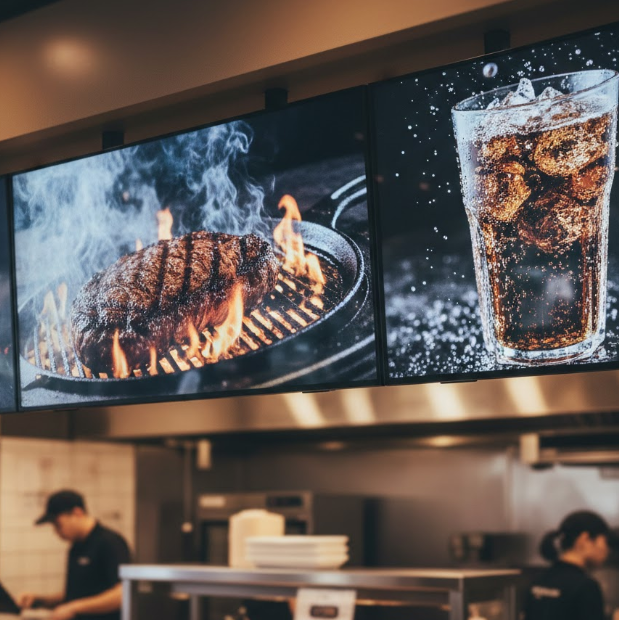
Immersive Solution: Adopting 4K dynamic Digital Menu Boards driven by edge computing.
Visual Reshaping:
Dynamic Induction: The steak on the screen is "sizzling" and steaming, and the bubbles in the ice-cold soda are constantly rising. These ultra-HD dynamic images can instantly activate the consumer's "mirror neurons" and trigger appetite.
AI Data Integration: The system combines foot traffic analysis with inventory data. When it rains, the screen automatically switches to close-ups of warm soup in warm tones; when the lunch queue is too long, the screen automatically recommends set meals that are faster to prepare.
Commercial Value: This "sensory induction" significantly shortens consumer decision-making time. Statistics show that stores applying dynamic and inductive content saw a 30% increase in the trial rate of new products and an average growth of 12% in average transaction value (ATV).
Core Technology: Why "Immersion" is More Than Just a Big Screen
Many brands have a misconception that buying a big screen equals "immersive." As a professional commercial display manufacturer, iMGS believes that true immersion comes from technical control over details (reflecting the E-E-A-T principle of professionalism):
Ambient Adaptation:
Store lighting environments are complex and variable. High-quality commercial display equipment must have built-in high-sensitivity light sensors. Under strong noon sunlight, screen brightness needs to automatically soar to over 3000 nits to ensure visibility; at night or on cloudy days, it must automatically soften the brightness to avoid glare. Being unreadable or too glaring will instantly break the immersion.
Seamless Fusion of Content and Space:
Immersion requires "eliminating borders." Whether it is a shaped screen or a corner screen, the physical seam processing capability of the hardware and the distortion correction capability of the software are crucial.
Zero-Latency Edge Computing:
When interaction is involved (such as gesture page-turning or AR makeup trials), latency is the killer of experience. Commercial displays in 2026 are equipped with high-performance SoCs as standard, supporting local edge computing to ensure that image rendering synchronizes with user actions without waiting for cloud transmission.
Conclusion and Call to Action (CTA)
From the artistic facades of luxury stores to the dynamic menus of fast-food restaurants, immersive commercial displays are no longer just display tools; they are part of brand assets and the infrastructure for the digital transformation of physical spaces. They are responsible for converting "passersby" into "potential customers" within the first minute they step into the store.
At iMGS, we don't just manufacture screens; we understand how to use light and shadow technology to empower commercial spaces. We are committed to providing commercial display terminals with high reliability and intelligent sensing capabilities.
Ready to reshape your store's "First Impression"?
Don't let your brand get lost in mediocre static displays.