


6,000m² Factory | 400+ Classic Cases | 85+ Patents | 1,000+ Projects |
Printed menus go out of date the moment a price changes. A digital menu board fixes that and does much more: it upsells at the exact moment a customer is deciding, switches from breakfast to lunch on its own, and makes the queue feel shorter. For restaurants, cafes, and quick-service chains, restaurant digital signage has shifted from a nice-to-have to a standard fixture. This guide explains why, shows the real numbers, and helps you pick the right setup before you order.
The Numbers Behind the Switch
Margins in food service are thin, so even a small sales lift matters. The research on digital menu boards is consistent, and it points one direction.
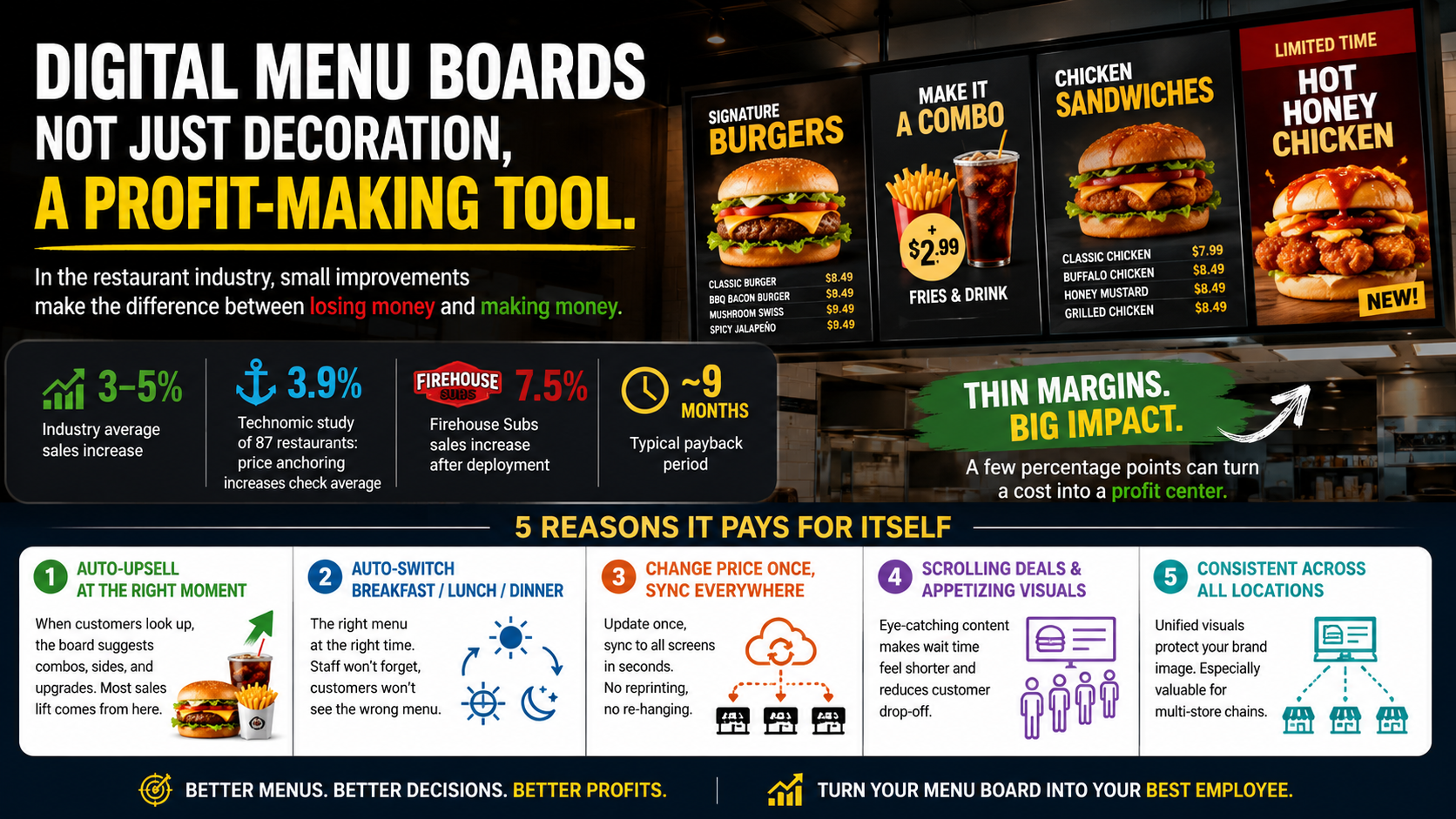
3–5% | Typical sales lift restaurants report after switching to digital menu boards (Networld Media Group industry review) |
3.9% | Average-check increase from price anchoring on digital menu boards, across 87 operations (Technomic, 2019) |
7.5% | Sales increase Firehouse Subs reported after deploying digital menu boards with strategic pricing |
~9 mo. | Common break-even point for a digital menu board investment (WAND Digital) |
Why Restaurants Are Leaving Paper Behind
A printed board is frozen. Change a price, add a special, or run a holiday promotion and you are reprinting and rehanging signs. A digital menu board updates in seconds from one screen, across every site. That is the core appeal of restaurant digital signage: the menu becomes something you control in real time instead of a static sign on the wall. Beyond convenience, the screen actively sells. Bright food photography and subtle motion draw the eye to high-margin items, which a paper board simply cannot do. Restaurant digital signage turns the menu from a list into a sales tool.
5 Ways a Digital Menu Board Pays for Itself
1. Upsell at the point of decision. The moment a customer looks up at the board is the moment to suggest a combo, a side, or a larger size. A digital menu board prompts that add-on every time, with no awkward sales pitch from staff. This is where most of the measured sales lift comes from.
2. Dayparting on autopilot. A digital menu board switches itself from breakfast to lunch to dinner on a schedule. Staff never forget to swap the board, and customers never see the wrong menu. This alone removes a daily source of errors and keeps the right items in front of people at the right time.
3. Instant price and item updates. Change a price once and it updates on every screen across every location. No reprinting, no rehanging, no inconsistency between sites. For a multi-site chain, this is the single biggest operational reason to move to restaurant digital signage.
4. Make the wait feel shorter. A queue feels longer when there is nothing to look at. An engaging digital menu board with rotating specials and appetizing visuals keeps waiting customers occupied, which lowers perceived wait time and reduces walk-offs during a rush.
5. Brand consistency across locations. Every screen shows the same layout, the same colours, the same promotions. For franchises, that consistency protects the brand and reassures customers, who expect the same experience at every branch. Restaurant digital signage makes uniformity effortless.
Real Numbers from Real Restaurants
The case for a digital menu board is not theoretical. After deploying digital menu boards with strategic price positioning, Firehouse Subs reported a 7.5% increase in sales. A broader Technomic study across 87 restaurant operations found that price anchoring on digital menu boards raised the average check by 3.9%, and noted that the flexibility of a screen made those tactics far easier to apply than on a static board. Industry reviews put the typical lift at 3 to 5 percent, with break-even often reached in around nine months. On thin restaurant margins, that is the difference between a tool that costs money and one that quietly makes it.
The Drive-Thru Opportunity
For quick-service brands, the drive-thru is where the volume is: an estimated 70% of fast-food purchases happen at the window. A digital menu board outdoors does the same job as one indoors, but the stakes are higher because the line moves fast and every second counts. Targeted combos shown right at the order point, limited-time offers that change by the hour, and clear, legible pricing all lift the average order without slowing the queue. Outdoor restaurant digital signage does need tougher hardware, with high brightness for direct sunlight and weatherproofing, which is exactly the kind of build a commercial supplier should provide as standard.
Choosing the Right Menu Board Setup
Three things decide the right configuration. First, placement. Most cafes mount one or more screens above the counter; tight spaces use a ceiling-mounted menu board to free up wall and floor room, while a compact counter unit suits small kiosks and food trucks. Second, screen grade. A digital menu board must be commercial-grade, built for long daily hours, higher brightness, and proper heat management, not a consumer TV that fails after months of continuous use. Third, ordering integration. Pairing the board with a self-order kiosk lets customers read and order in one flow, compounding the upsell effect.
Sizing follows the menu. Cafes typically run 32” to 55” screens above the counter; larger quick-service restaurants line up several panels or a menu-board video wall. Keep the layout simple, with large headings, strong contrast, and clear groupings, so customers decide faster and the queue keeps moving.
One point first-time buyers overlook is content. A screen is only as good as what plays on it: the early case studies show that simply copying a paper menu onto a digital menu board does little, while well-designed visuals and subtle motion are what drive the sales lift. Plan for a simple content system that lets non-technical staff swap items, prices, and promotions in a few clicks. Good restaurant digital signage ships with a built-in media player and an easy interface, so you are not buying a screen and a software headache separately.
Why Source Restaurant Digital Signage from iMGS
Xiamen iMGS Technologies builds every digital menu board in its own 6,000m² factory and tests each unit before shipping. Hardware carries ISO 9001, CE, FCC, China 3C, and UL certifications, so customs clearance in Europe, North America, and Australia stays clean. With 400+ classic cases and 85+ patents, iMGS supplies restaurant digital signage as commercial-grade hardware built for all-day operation, and handles OEM and ODM from enclosure to software image. Read the factory background on the direct manufacturer page.
Whatever your venue, there is a matching model ready to quote:
23.8” Desktop Digital Menu Board — Cafes & Restaurants Compact counter-top menu board with built-in Android player. Ideal for cafes, coffee shops, and food trucks. |
Ceiling-Mounted Digital Menu Board AD Screen Hang screens from above to save wall and counter space. Great for tight service areas and fast-casual layouts. |
Full Digital Signage Range Desktop, wall-mounted, ceiling, and dual-sided restaurant digital signage in one place. |
Ready to upgrade your menu to a screen? Tell us your venue type, screen size, and how many sites. We reply within one working day with pricing and a recommended menu board setup. Email: irenepan@fj-imgs.com Phone / WhatsApp: +86-18850151946 |