


32" / 43" Two Sizes | See-Through LCD Glass | 50,000 hrs Rated Life | ISO · CE · FCC · UL Certified |
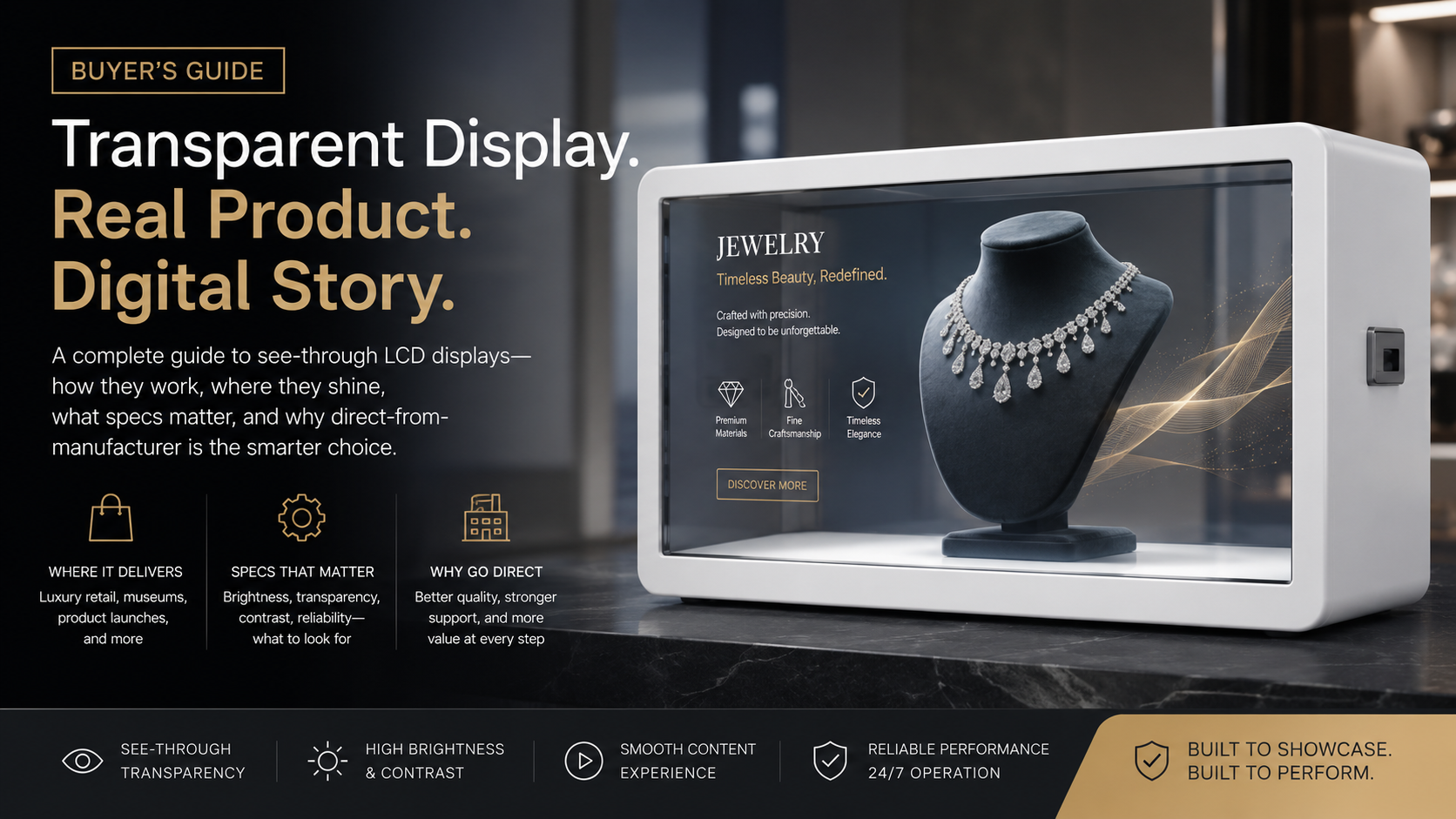
Imagine a glass cabinet that holds a real watch, a sneaker, or a perfume bottle — and at the same time plays video across the glass itself, so the product appears wrapped in floating text, price tags, and motion graphics. That is a transparent display case: a see-through LCD panel mounted as the front of a showcase, with the physical product sitting visibly behind the glass. Shoppers see the real object and the digital story at once.
It is one of the more eye-catching formats in retail right now, and one of the least understood by buyers. A transparent display case is not the same as a normal screen, not the same as a glass cabinet, and not priced like either. This guide explains what the format actually is, where it earns its keep, the specs that matter, and how to brief a digital signage manufacturer so you order the right unit the first time.
300 nits | Typical brightness of a transparent panel — lower than a solid display, because light passes through the glass |
32" / 43" | The common sizes for retail-counter and floor-standing see-through showcase units |
70%+ | Of shoppers say an interactive or unusual display makes them more likely to stop and look, per in-store engagement studies |
1. How a Transparent Display Case Works
The heart of the unit is a transparent LCD panel — the same liquid-crystal technology as an ordinary screen, but built without the solid white backing layer that normally blocks the view. Instead of being lit from directly behind, the glass is lit from the edges, which lets you see straight through it to whatever sits inside the cabinet.
When the screen plays content, the bright areas of the image appear on the glass while the dark areas stay see-through. The effect is that text and graphics seem to hover in front of the real product. Put a lit object inside the case — a handbag on a small pedestal, a bottle under a spotlight — and the digital layer and the physical layer combine into a single display that neither a plain screen nor a plain cabinet could achieve alone.
Because light travels through the glass, a transparent display case runs at a lower brightness than a solid panel — around 300 nits versus the 500 nits of a standard signage screen. That is normal for the technology, and it is why a transparent display case performs best with good cabinet lighting on the product inside.
2. Where a Transparent Display Case Earns Its Keep
This format is not a general-purpose screen. It shines in a specific situation: when you have a physical product worth showing and a digital story worth telling, and you want both in the same frame.
Luxury and Jewelry Retail
A watch or a ring sitting in a transparent display case, with specifications, pricing, and brand film playing across the glass, turns a static vitrine into a moving brand statement. The real object reassures the shopper it is genuine; the digital layer adds the storytelling that a printed card never could.
Museums and Exhibitions
Curators use see-through cabinets to pair an artifact with animated context — a relic behind the glass, its history scrolling in front of it. Visitors get the authentic object and the interpretation in one glance, without a wall of text beside the case.
Beverage, Cosmetics, and Product Launches
At a launch event or a flagship counter, a transparent display case lets a brand frame a single hero product in light and motion. Spirits brands, fragrance houses, and electronics makers all use the format to make one item feel like the only thing in the room.
3. Key Specs to Check Before You Buy
A see-through showcase has its own spec priorities, different from those of a regular advertising screen. Here is what actually matters:
• Size and orientation: 32" and 43" are the practical sizes. Confirm whether you need horizontal (16:9) for a counter unit or vertical (9:16) for a floor-standing cabinet — the iMGS T-Series can switch between landscape and portrait mounting.
• Touch: optional on the vertical models. Add it only if shoppers need to interact; skip it for pure display-and-play to save cost.
• Brightness and contrast: 300 nits with a 3000:1 contrast ratio is standard for transparent glass. Pair it with strong internal cabinet lighting so the product reads clearly.
• Lifespan: a commercial-grade panel should be rated around 50,000 hours of use — the iMGS unit meets that, which matters for an always-on retail fixture.
• Connectivity and OS: Android with USB, WiFi, RJ45, and HDMI covers nearly every content-management setup.
4. Transparent Display Case vs. a Standard Screen
A see-through showcase is the right call only in specific cases. This table shows where it wins and where a solid panel is the smarter, cheaper choice:
Factor | Transparent Case | Standard Screen |
Shows real product | Yes, behind glass | No |
Brightness | ~300 nits | 500+ nits |
Best for | Hero product display | General advertising |
Cabinet lighting | Essential | Not needed |
Wow factor | Very high | Standard |
Cost | Premium | Lower |
In short: if there is no physical product to show, a standard advertising screen does the job for less. The transparent display case is worth its premium only when the real object is part of the message.
iMGS Touch Screen Transparent Display Case 32" / 43" · see-through LCD glass · landscape or portrait · touch optional · Android · 3000:1 contrast · 50,000-hour rated · OEM available |
5. Why Source a Transparent Display Case from the Factory
Transparent showcases are a niche format, which means a lot of resellers list them without really understanding the brightness trade-offs, the lighting requirements, or the custom cabinet options. Buying through that kind of middleman often means generic advice and a markup on top — the opposite of what a specialist digital signage manufacturer offers.
Going straight to the digital signage manufacturer that builds the unit changes that. You get accurate guidance on sizing and lighting, the ability to customize the cabinet enclosure, and factory pricing. iMGS engineers and assembles its own transparent cases in Xiamen, showed the range at the 2024 NRF APAC show in Singapore, and holds ISO9001, China 3C, CE, FCC, and UL certification — the marks most US and EU retail installations require. A digital signage manufacturer at this level can also tailor the enclosure colour, branding, and dimensions to match your store fixtures.
As a full-range digital signage manufacturer, iMGS produces the transparent display case alongside its wider touch screen kiosk and digital signage lines, so a brand rolling out mixed fixtures can source see-through cabinets, interactive screens, and shelf screens from one factory. Working with a single digital signage manufacturer across formats also keeps branding and content consistent store-wide.
6. Buyer Checklist
1. Decide horizontal (counter) or vertical (floor-standing) before specifying the unit
2. Confirm the product you want to showcase fits the cabinet depth and lighting
3. Add touch only if shoppers genuinely need to interact
4. Plan strong internal cabinet lighting — transparent glass needs the product lit to read well
5. Check the rated lifespan (aim for ~50,000 hours) for always-on retail use
6. Confirm certifications: ISO9001, CE, FCC, UL for US and EU compliance
7. Buy from the digital signage manufacturer directly, not a reseller, for accurate lighting advice and OEM options
8. Ask the digital signage manufacturer about OEM enclosure colour, branding, and custom sizing
Planning a See-Through Display for Your Brand? Tell us what you want to showcase and where. We will recommend the size, orientation, and touch option that fit — and quote OEM if you need custom branding. Reach Irene at irenepan@fj-imgs.com · +86-18850151946 |