



Small Screens Are Sufficient
In the digital age, the "network" concisely symbolizes the core characteristics of modern technology. Just as the poet Bei Dao depicted the intricate interweaving of modern society with his one-character poem "Network", the Internet and the Internet of Things (IoT) have closely connected individuals around the world through their invisible bonds, creating an unprecedented network of information and communication.

If we apply this perspective to the commercial display field, we will also find it is like a network: new advertising demands continue to emerge, and more and more electronic screens are installed in retail spaces to capture users' attention.
Thanks to technological innovation, the emergence of LCD desktop screens has further filled the delicate parts of this network, forming the meshes and nodes of the screen matrix.
32 Inches, Sufficiently Flexible
The first impression of a 32-inch desktop screen is: compact. Among a host of commercial display screens often measured in square meters, its size seems unremarkable.
However, different from the strong visual pleasure brought by large screens, the positioning of desktop screens is more inclined to precision and flexibility: delivering more information in specific areas, efficiently displaying key content, and adapting to more application scenarios.

With its wireless and lightweight design, the desktop screen solves the problem that traditional LED screens are difficult to move, reduces restrictions on venues, and can be moved to any location at any time for advertising.
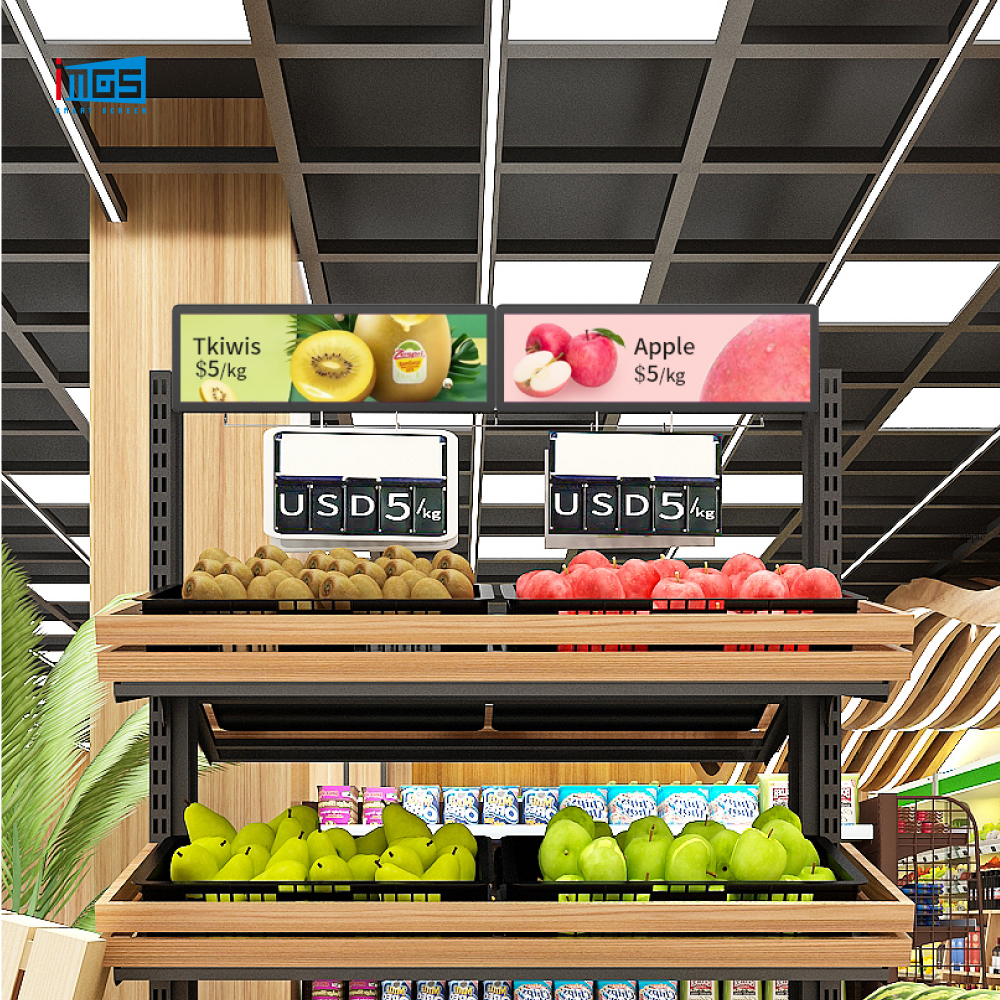
In small and medium-sized retail spaces, it is easier to realize the value of LCD desktop screens: placed on the countertop, customers will glance at them from time to time when wandering in the product area; placed at the storefront desk, they continuously display seasonal promotions and best-selling products.
Its positioning is not to spread information extensively, but to better help users understand products and assist them in making choices at precise locations.
Small Screens Are Also Mainstream

Just as mobile phone screens are getting larger and larger, leading to a debate between large screens and small screens, people also have questions about advertising screens: are large screens more valuable than small screens?
It is undeniable that large screens dominate the commercial display market, but small screens represented by desktop screens also have undeniable value, which is to further amplify the value of high-quality content.
From the content perspective, the promotion functions of desktop screens are almost the same as those of large screens. They can not only tell brand stories, but also help create best-selling products in stores and improve store marketing.
In small stores, they are free advertising spaces that do not take up space; in large stores, they are an important part of daily marketing and can be placed at cash registers, windows, middle islands and other places to provide different functions for different marketing needs.
The difference from large screens is that desktop screens can make full use of limited space. Only a small area is needed to continuously repeat content, ensuring that high-quality advertising content is seen by users.
For example, in the product area, desktop screens can cycle through multiple SKU pages and dynamically display in-store products, making the product presentation more vivid and interesting, unlike traditional PVC billboards and KT boards which are rigid.
Marketing Toolbox, Time-Saving and Labor-Saving
A good commercial advertising screen should be a marketing toolbox for retailers, using more intelligent software and hardware to simplify complex promotion processes.

Its high-saturation image quality can create an atmosphere and make information display more vivid; its pictures can be updated in real time without the need to print paper materials; it has a built-in cloud control system, eliminating the need for frequent manual material replacement; it adds intelligent interactive functions, allowing consumers to participate...
Image
Just as mobile phones have simplified people's lives, desktop screens have also simplified the complicated process of store operations and improved the digital operation capabilities of retail spaces.
How to Choose Between Desktop Screens and KT Screens?
When we talk about desktop screens, we may compare them with another product, namely the KT screen introduced earlier.
From small size, light weight, portability to multimedia playback, these characteristics of desktop screens are somewhat similar to those of KT screens. Therefore, a question arises - how to choose between the two in retail spaces?
Based on Differences in Usage Scenarios
Desktop screens are generally placed on vertical surfaces inside the store, such as countertops, windows, shelves, storage tables and other areas. They do not occupy aisle space, and even small milk tea shops can place them easily.
KT screens are mostly placed on the ground and require a certain reserved space for placement. In terms of usage scenarios, KT screens can be placed both inside the store and outside, such as the area in front of the store.

Based on Differences in Content Display
Desktop screens are mainly in landscape orientation. This ratio is parallel to the human eye's line of sight, providing a more comfortable visual experience and a wider field of view, which is suitable for playing video advertising content.
KT screens are mainly in portrait orientation, which is more in line with users' browsing habits, and the content forms are mainly posters, long pictures, text information, etc.
In conclusion, in retail spaces, there is no best digital advertising product, only products that are more suitable for the store's marketing needs.
The "Invisible Network"
If the advertising matrix in retail spaces is a "network", then our expectations for it should be intelligent, convenient, and interconnected.
The cloud control system behind desktop screens is precisely the needle and thread for building this network. Through this "needlework", devices are connected with devices and content with content, thus "networking" the entire screen matrix.
Basically, there may be a variety of digital display devices in retail spaces, such as desktop screens, advertising machines, grid screens, window screens, etc., each playing its role in different positions.
When these devices are all in the ecosystem of the cloud control system, they have unified content management and unified visual experience. It is the connections among them that build a digital spatial field, thereby driving sales growth.