



In the commercial display industry, the first thing many clients say when inquiring about a project is: "I want an LED screen for my lobby," or "I need a large TV for my outdoor window."
Experienced project managers, however, don't jump straight to a quote. Instead, they ask a series of critical questions: "How far away is the audience?" "What are the ambient lighting conditions?" "What kind of content will you be playing?"
While the simple rule of "LCD for indoors, LED for outdoors" is a quick starting point, it no longer covers today’s complex application scenarios. The true "Golden Rules" for selection must be a comprehensive balance of display principles, viewing distance, brightness, and cost.
I. Debunking the Myth: Why One Size Doesn't Fit All
In the past, this "indoor vs. outdoor" rule generally held true. However, with the maturation of Fine-Pitch LED (P1.9, P1.2, or even P0.9) technology, LEDs have made a massive entry into the indoor market, competing directly with LCD video walls.
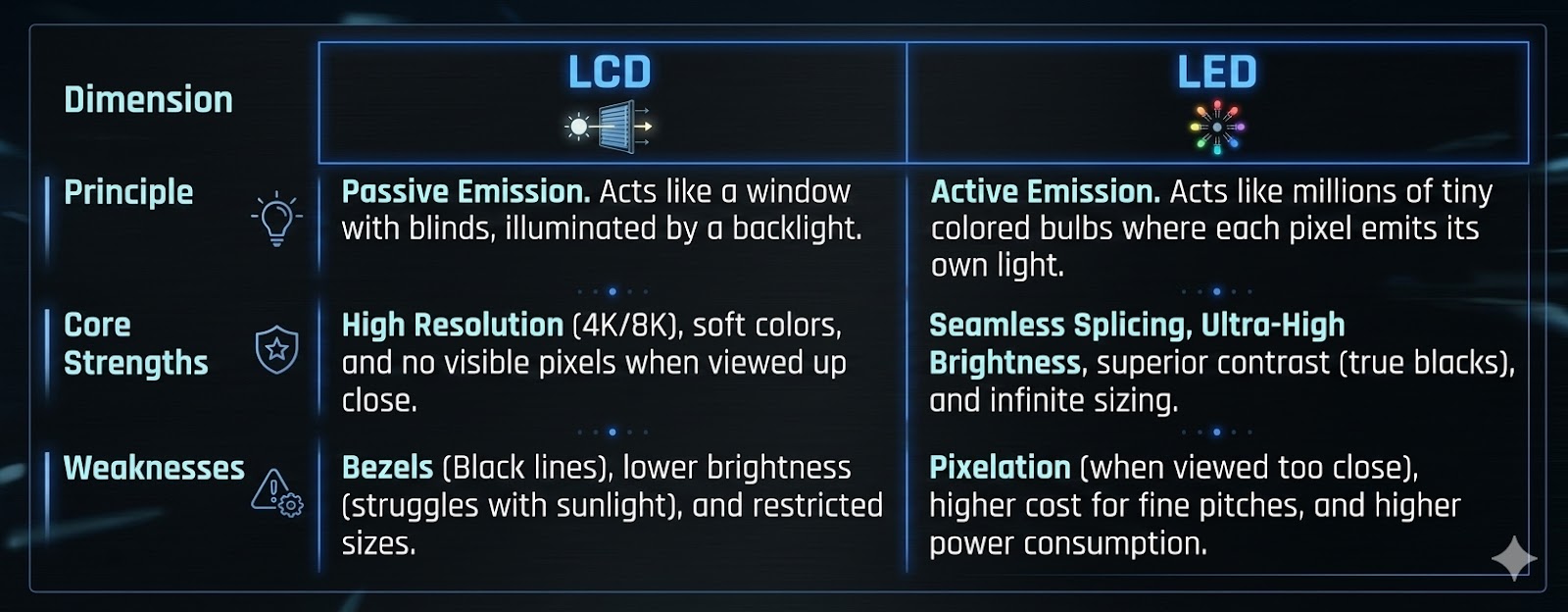
Let’s look at the physical essence of these two technologies:
II. The "Golden Rules": Three Critical Dimensions
To make a decision you won’t regret, you must answer these three questions:
Rule 1: Viewing Distance (How far is the audience?)
This is the primary criterion for choosing between LCD and LED.
Distance < 2 meters: Choose LCD.
The Logic: LCD pixels are microscopic. Even if your face is against the screen, the image remains sharp and smooth. Using LED at this distance results in a "screen door effect," where individual diodes become visible, ruining the experience.
Case Study A: Elevator Signage. Since viewers stand only 0.5 meters away, a 4K LCD is essential to ensure text and product details are sharp and comfortable to look at.
Distance > 5 meters: Prefer LED.
The Logic: At this distance, the human eye can no longer distinguish individual LED diodes. You see a perfect, seamless, massive image. Conversely, LCD bezels become distracting at long distances.
Case Study B: Banquet Halls/Theaters. With audiences 5–10 meters away, a Fine-Pitch LED (P2.0 or P1.5) creates a stunning, integrated stage backdrop. An LCD video wall's black lines would disrupt the visual flow.
Rule 2: Ambient Light (How bright is the environment?)
This determines whether your content is actually legible.
Standard Indoors (< 500 nits): LCD Wins.
The Logic: Offices and malls have gentle lighting. LCD screens (350–700 nits) offer soft colors that prevent eye fatigue over long periods and offer excellent cost-performance.
Case Study C: Conference/Control Rooms. These scenarios require long-term viewing of text or data. LCD is the best choice for clarity and eye protection.
Strong Light/Semi-Outdoor/Outdoor (> 1000 nits): LED Dominates.
The Logic: Sunlight is incredibly powerful. An LCD screen looks like a black slate under direct sun. Only active-emission LEDs (3000–5000+ nits) can maintain vivid, clear images against the glare of the sun.
Case Study D: High-Bright Street Windows. Placing a standard TV in a window often results in nothing but reflections. The correct solution is a High-Bright LCD Window Display (specialized LCDs up to 2500 nits) or an Outdoor LED Screen.
Rule 3: Content Type (What are you playing?)
Static text, complex charts, or high-precision details: Choose LCD. Only LCD’s high pixel density can accurately render complex information.
Dynamic videos, stage backdrops, or visual spectacles: Choose LED. The superior contrast and seamless nature make it the go-to for "cinematic" advertising impact.
III. Application of the Golden Rules: Industry Scenarios
Let’s apply these rules to common industry needs:
Chains & Fast Food (Indoors):
Application: Digital Menu Boards above the counter.
Selection: LCD Signage.
Reason: Close viewing distance (1–2m) and text-heavy content (prices/items). Clarity and cost-efficiency are the priorities here.
Luxury Retail (Indoor Lobby):
Application: A dual-story brand feature wall.
Selection: Fine-Pitch LED (P1.5 or P1.2).
Reason: Viewing distance is typically >3m, and the goal is maximum visual impact. The seamless, integrated image of an LED wall perfectly showcases luxury textures.
Corporate Showrooms/Command Centers:
Application: Video Walls.
Selection: Depends on Bezel tolerance vs. Budget.
Reason: If the budget allows for a perfectly seamless look, choose P1.2/P0.9 LED. If razor-thin lines are acceptable in exchange for higher resolution and lower cost, choose an 0.88mm Bezel LCD.
IV. Summary
There is no "perfect" device—only the "right" solution. "Indoors for LCD, outdoors for LED" is just a rough guide. The true Golden Rules for Selection are:
Define Distance First: Choose LCD for close-up detail; choose LED for seamless long-distance views.
Assess Brightness Second: Intense light requires high-bright LED.
Balance Content and Budget: Match the physical characteristics to your needs, then choose the most cost-effective path.
Wondering which display is the perfect fit for your project?
Don’t let complex technical specs stall your decision. Fill out the "Let's Talk" contact form below with your specific application (indoor/outdoor) and budget requirements. Our expert team will reach out within 24 hours to provide a one-stop solution—from selection to installation.