


6,000m² Factory | 400+ Cases | 85+ Patents | 1,000+ Projects |
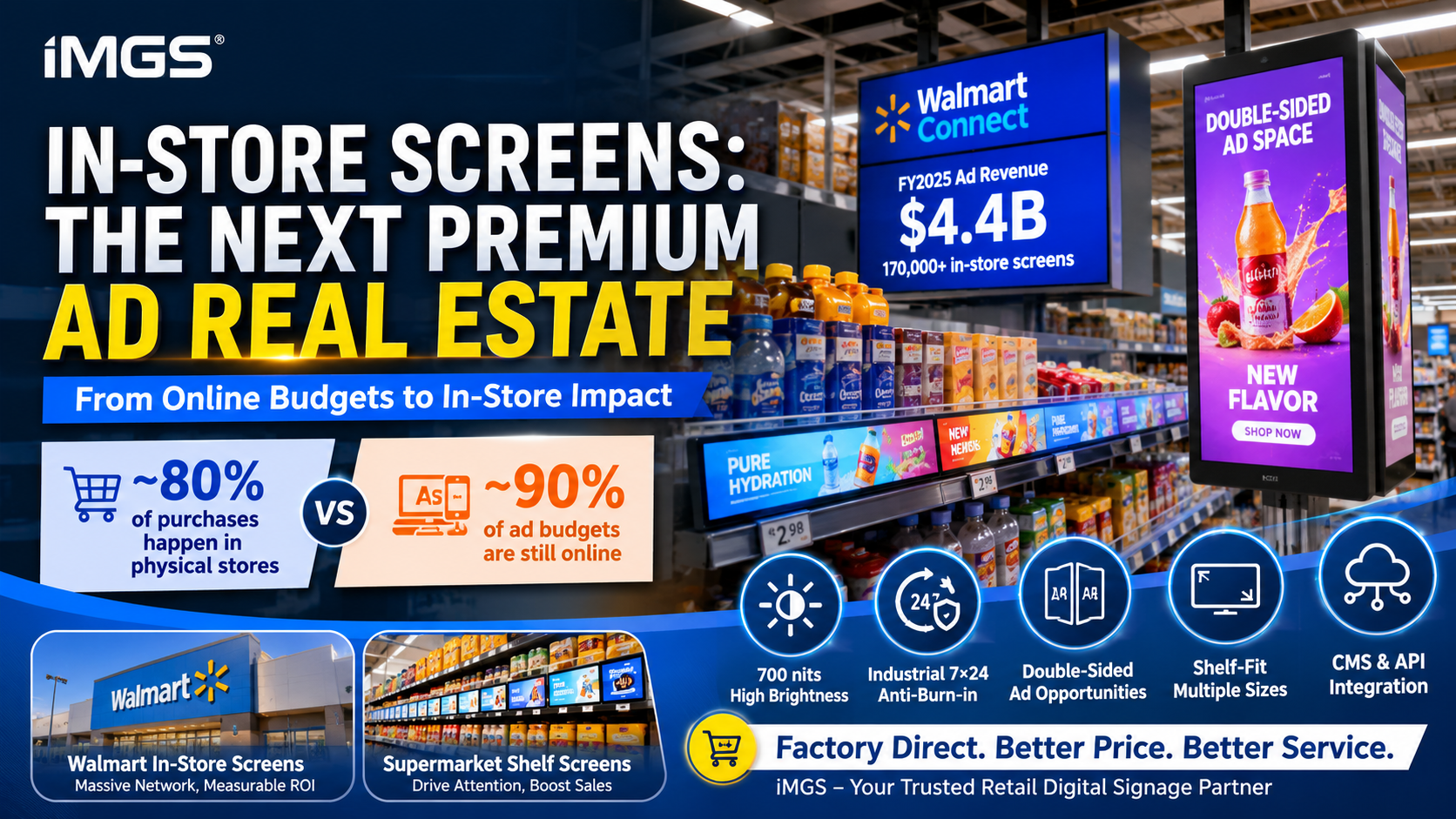
Retail media has a strange gap in it. Roughly 80% of consumer spending still happens inside physical stores, yet about 90% of retail media ad budgets go to online placements. That mismatch is the whole story of 2026. Brands have figured out that the shopper standing in the aisle is worth more than the one scrolling at home, and the money is starting to follow. U.S. retail media grew around 20% in 2025, and the in-store slice is now the part everyone wants to claim. That slice runs on retail digital signage.
For anyone buying retail digital signage now, that shift changes the question. It used to be “what screen looks nice on the wall.” Now it is “what retail digital signage can hold up as paid ad space, running third-party campaigns seven days a week.” The hardware has to earn its keep. This guide covers what matters when you spec retail digital signage for a retail media build, and where a direct shelf screen manufacturer fits in.
Why Store Screens Suddenly Count as Advertising Real Estate
Walmart Connect is the clearest proof. The company booked $4.4 billion in global ad revenue in FY2025, up 27% year over year, and runs roughly 170,000 digital screens across about 4,600 U.S. stores. Self-checkout lanes, the TV wall at the back, screens near the shelves. Each one is now inventory a brand can buy. CFO commentary has openly called advertising one of the things that pushed U.S. e-commerce into profit.
EuroShop 2026 in Düsseldorf told the same story from Europe. In-store screens and self-service touchpoints were treated as premium ad space, sellable against verified first-party shopper data, right at the moment someone decides what to put in the basket. The Grocery Doppio report puts the U.S. in-store media market at about $8.5 billion today, with 73% of grocers ranking media monetization a C-suite priority.
The reason is simple, and it is worth stating plainly: a grocery cart is shoppable every week. A living room couch is not. Screens in the aisle reach the shopper at the decision, which is exactly where a brand wants its message. That makes retail digital signage a revenue surface, not a decoration. And a revenue surface has to be reliable, or the ad dollars stop. That is why the choice of retail digital signage hardware, and the choice of shelf screen manufacturer behind it, carries more weight than it used to.
$8.5B | U.S. in-store retail media market today (Grocery Doppio) | ~20% | U.S. retail media growth in 2025 |
170,000 | digital screens running across Walmart U.S. stores | 73% | of grocers now rank media monetization a C-suite priority |
Five Things Buyers Should Ask Before Spec'ing Retail Digital Signage
When a screen becomes paid ad space, the spec sheet questions change. Here are the five that decide whether a retail digital signage deployment makes money or becomes a maintenance headache, and the five a good shelf screen manufacturer should be able to answer without hesitating.
1. Brightness that survives store lighting
Supermarket aisles and shop windows are bright. A 300-nit panel that looks fine in a showroom washes out under store lights or near glass. For shelf and window positions, 700 nits is the practical floor. Ask for the measured brightness, not the marketing number.
2. Industrial-grade panels rated for 7×24
Ad screens run all day, every day. Consumer TV panels are not built for that duty cycle and will show image retention within months. You want commercial panels rated for continuous operation, with an aluminum-and-sheet-metal chassis that dissipates heat instead of trapping it. This is the single biggest reliability difference between a shelf screen manufacturer that builds its own panels and a reseller flipping consumer stock.
3. Double-sided positions for aisle traffic
Foot traffic moves in two directions. A single-sided screen in an aisle or entrance throws away half its audience. Double-sided floor units double the impressions from the same floor footprint, which matters a lot when each impression is sellable.
4. Sizes that actually fit the fixture
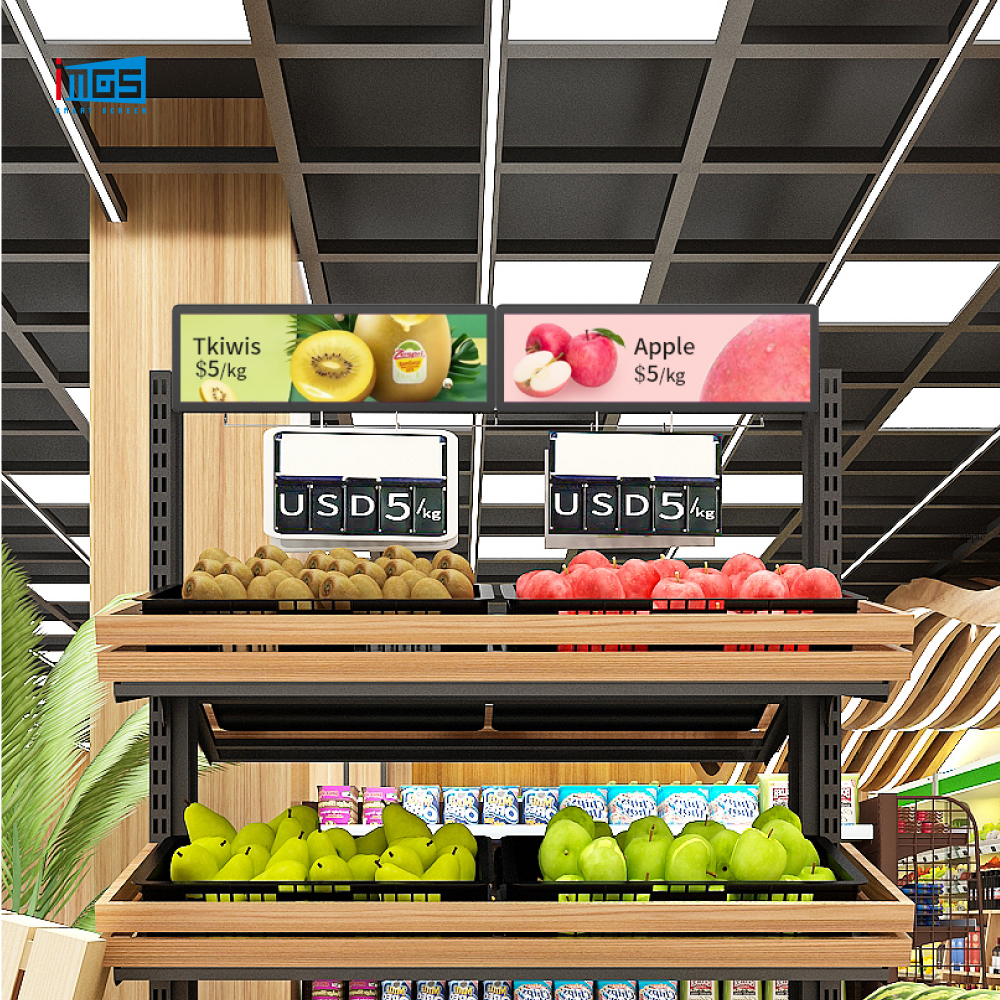
Shelf edges, gondola ends, and window ledges have fixed dimensions. A standard 16:9 panel rarely fits a shelf rail. Stretched bar screens are built for that exact slot, sitting flush with the shelf without stealing facing space. A shelf screen manufacturer that cuts panels to your fixture dimensions saves expensive rework later, which is the kind of detail that separates real retail digital signage suppliers from box-shifters.
5. CMS and integration interfaces
A retail media network schedules and swaps content across many sites at once, often pulling promotions from a POS or inventory feed. Retail digital signage needs a real content management system plus the ports for it: USB, RJ45, WiFi, optional HDMI and 4G. Without that, campaigns cannot run at scale and the ad inventory never gets sold.
Matching iMGS Hardware to Retail Media Positions
iMGS designs and builds these retail digital signage formats in-house, so the spec can be tuned to the position rather than forced to fit a stock unit. As a shelf screen manufacturer with its own production base, the build starts from the fixture. Below are two positions and the shelf screen manufacturer formats that suit them.
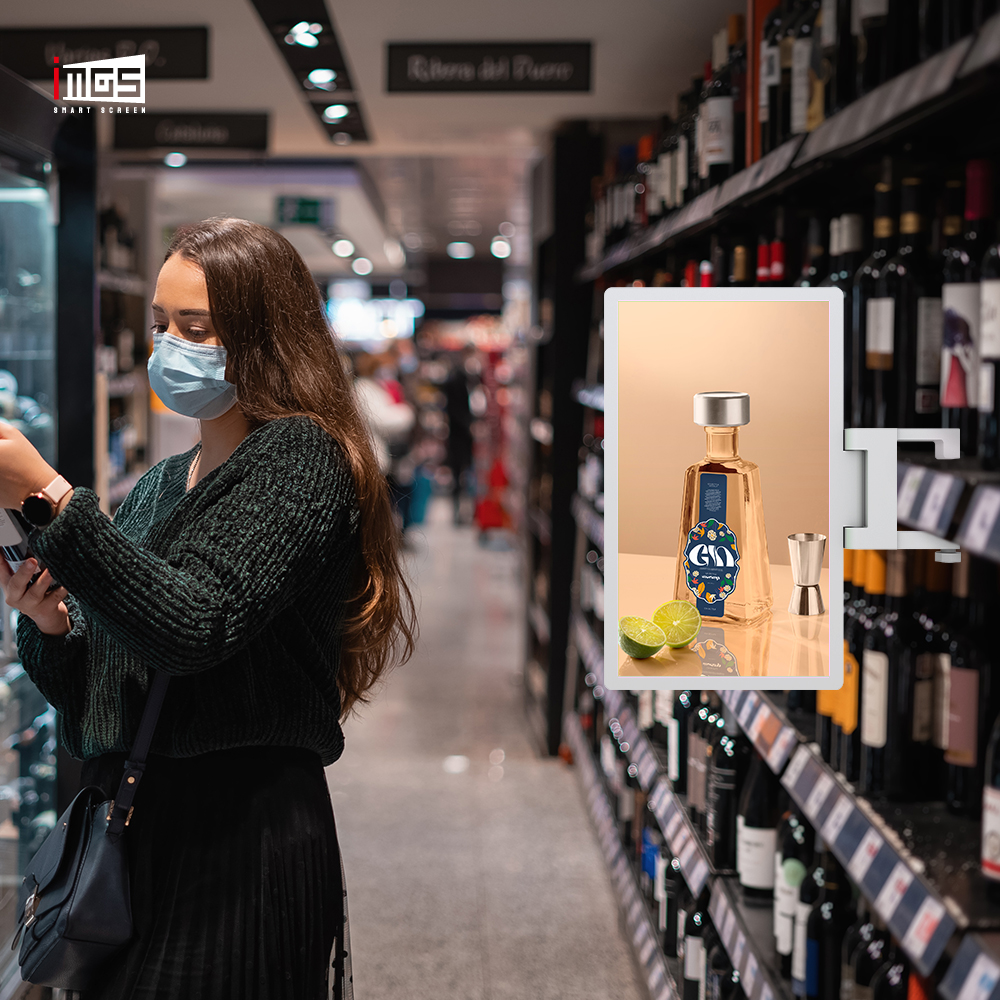
Shelf and gondola positions — Stretched Bar Shelf Screen An ultra-wide bar panel built to sit flush along a shelf rail, with a 700-nit high-brightness display that stays readable under supermarket lighting. It replaces paper price cards with promotions that update in real time across every store. See the shelf screen range. |
Aisle and entrance positions — Dual-Sided Floor Display A 55-inch double-sided floor unit with 4K (3840×2160) resolution, designed for malls, supermarket aisles, and airport concourses where traffic flows both ways. One footprint, two sellable faces. See the dual sided advertising screen for mall and aisle builds. |
Two Deployments Worth Studying
Walmart Connect: screens as a media business
Walmart did not just hang screens. It turned about 170,000 of them into inventory it sells to brands, tied to first-party purchase data, and grew that business to $4.4 billion in FY2025. The lesson for a smaller network: the screens are the foundation the revenue model sits on. If the displays fail or look poor, the ad product fails with them. This is why the shelf screen manufacturer choice is the product, not a side concern.
Supermarket shelf screens: dynamic promotion at the edge
Grocers deploying shelf-level screens and motion-triggered content have reported real lifts in basket value by shifting promotions based on dwell-time and shopper behavior. The mechanism is direct: a steak promotion next to the wine, a “buy the second at half price” message that updates instantly across every store. Paper cannot do that. A shelf screen manufacturer that matches panel size to your fixtures turns a static shelf into a sellable, updatable surface.
Why Source Retail Digital Signage Direct from iMGS
Most companies selling store screens are distributors. They buy panels, mark them up, and pass on whatever the upstream factory shipped. When a retail media network depends on those screens daily, that gap matters. Working with the actual shelf screen manufacturer closes it.
• Factory pricing, with no distributor margin stacked on top.
• OEM and ODM builds: change the size, brightness, touch type, OS, storage, or housing to fit the fixture and the brand.
• 100% testing before shipment, with industrial panels rated for continuous retail duty.
• 85+ patents and ISO9001, CE, FCC, and UL certification behind the build.
iMGS is a direct manufacturer, not a reseller. For a retail media build, that means the spec, the panel grade, and the after-sales line all trace back to one shelf screen manufacturer instead of a supply chain you cannot see into. That traceability is what keeps a retail digital signage network running long after the install crew leaves.
Source Your Retail Display Hardware Direct from the Factory iMGS builds retail digital signage at our own 6,000m² base in Xiamen. Send us your store layout, screen sizes, and brightness needs. OEM and ODM welcome. Email: irenepan@fj-imgs.com Phone: +86-18850151946 Browse all products · Send an inquiry |